
Flat Steel Market: Minor Correction And Potential For Future Price Hike

The flat steel market has witnessed a steady price increase this week, with prices offered higher than the previous weeks through the major manufacturers’ end. However, the spot market for flat products in the trade segment had a minor downward correction of Rs 500-1,000/ton. Let’s take a closer look at the current state of the flat steel market, prices, trade movements, prospects, and insight.
Flat Steel Price Movement And Trade Movement
- Current Prices- HRC prices currently stand at Rs 60,000-60,500/ton ex Delhi NCR, Rs 61,00/ton for Mumbai and Chennai, and Ahmedabad on an ex-yard basis. CRC prices are at Rs 66,000/ton ex Delhi NCR, Rs 66,500-67,000/ton for Mumbai and Chennai, and Ahmedabad on an ex-yard basis.
- Price Movement- In Q1 of 2023, after a sharp increase on 20 January 2023, due to improved domestic and export demand, buyers postponed bulk bookings due to high offers on 10 February 2023. On 1 March 2023, HRC prices recovered due to higher steel and scrap prices across the globe.
- Trade Movement- Local demand for HRC is mainly driven by availability, while global prices are on the rise due to an increase in offers by China. China has raised prices for May 2023 delivery, and Russian mills have decreased their exports to India. Indian mills are focusing on exports to gain higher prices, which may lead to a potential price hike in the near future.
- In contrast to Indian domestic trades, the current lackluster demand in the local market has resulted in traders and distributors lowering prices by Rs 500/ton across all markets. The weakness in the markets throughout the country is due to a low volume of customer inquiries, which has contributed to the reduced demand.
Future Market Outlook
Despite the current market conditions, the market outlook in the upcoming month appears positive due to surging prices in the international markets. Hence, it is anticipated that prices should improve in the upcoming days. Despite the positive indicators globally, the prices in the domestic market appear to be range-bound in the near term due to local sentiments.
Insight
The flat steel market has seen a minor correction, but it has the potential for a future price hike due to rising global demand and the possibility of Indian mills increasing their export focus. To sum up, while the flat steel market has experienced a minor setback, there are indications of a bright future ahead.
Read more: Indian Pig Iron Prices Trending Lowest Of 2023, Further Fall Seems Limited
Suggested Readings

MS Angle and Channel: Difference, Sizes & Weight
TL;DR: MS angle is an L-shaped steel section for bracing and light framing. MS channel is a C-shaped section that carries load across a span. Angles cost less to fabricate, while channels resist bending better. They are not interchangeable. This guide compares shape, weight, size, and cost, so fabricators and contractors can pick the right

ISMC Size Chart: MS Channel Weight per Meter, Sizes & Uses
TL;DR: MS channels come in standard ISMC sizes under IS 808, each with a fixed weight per meter that determines load capacity and material cost. ISMC 100 weighs 9.56 kg/m; ISMC 150 weighs 16.80 kg/m; ISMC 200 weighs 22.30 kg/m. This guide covers the full size chart, procurement checklist, and how to source verified MS
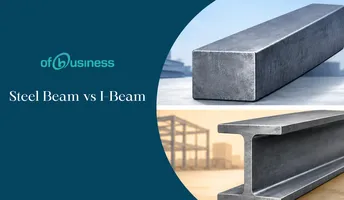
Steel Beam vs I-Beam: Structural Differences Explained
TLDR: Steel beam vs I-beam is a key comparison in construction, affecting strength, cost, and design. This guide explains structural differences, I-beam vs H-beam, beam dimensions, and standard I-beam sizes with charts. Understand steel beam vs I-beam clearly to choose the right section for better load performance and efficient material use. The comparison between steel

