
Steel Market Update: TMT Faces Dull Demand And Prices Soften
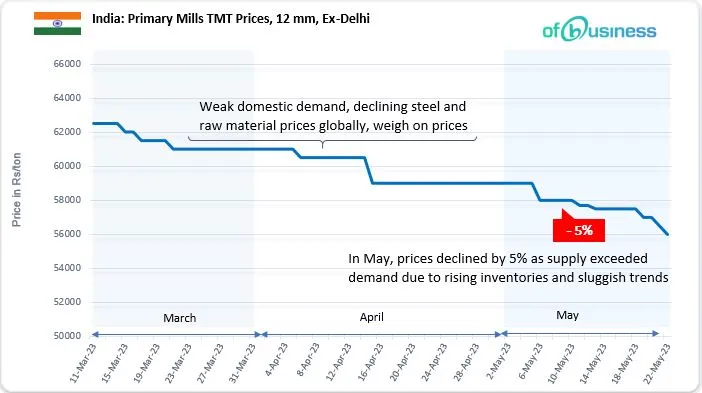
Currently, the TMT market in India is grappling with the impact of sluggish demand, leading to a softening of prices for both primary and secondary mills. The mills are facing a surge in inventories compared to the average maintained, resulting in downward pressure on prices. In this article, let’s explore more about the TMT market.
Present Situation
- Price Drop- The primary mills’ TMT prices in India have witnessed a decline of Rs 500-1,000/ton ($6-12/ton), while the secondary mills have also recorded corrections of Rs 300-700/ton against the operative prices during the last week. The low confidence in the market, influenced by sluggish global trends, continues to weigh on prices.
- In addition, to the decline in Finished Steel prices, the prices of secondary mills’ Sponge Iron, and Billet recorded a drop of Rs 200-400/ton, day-on-day.
- Contributing Factors- One of the contributing factors to the dull demand is the declining price of raw materials such as coal and iron ore. This indicates less support in the Steel market, leading to a decrease in necessity-driven demand. As a result, the market is experiencing excess supply, further intensifying the drop in price range, industry participants reported to OfBusiness.
Current Prices (12-25 MM)
- Primary TMT- The current operative primary TMT prices are as follows:
- Ex-Mumbai: Rs. 55,000-56,000/ton (down by Rs. 1,000/ton)
- Ex-Delhi NCR: Rs. 55,500-56,000/ton (down by Rs. 500/ton)
- Ex-Vizag: Rs. 53,500-54,000/ton (down by Rs. 500/ton)
Note: The above prices are the prices offered by companies directly to the institutional and corporate buyers and retail prices are Rs 1,000/ton more than the prices mentioned above.
- Secondary TMT- The last operated secondary TMT prices are as follows:
- Raipur: Rs. 48,500-48,700/ton
- Hyderabad: Rs. 52,500-53,000/ton
- Delhi: Rs. 52,500-52,700/ton
- Ahmedabad: Rs. 53,000-53,500/ton
- Jalna: Rs. 52,000-52,500/ton
- Wardha: Rs. 49,500/ton
Market Outlook
TMT prices are likely to remain under pressure or volatile within the current range. If the demand and global market trends turn positive, there might be some relief. However, if the sluggish trends continue, the mills may be forced to further cut prices as inventories continue to accumulate with distributors and plants.
OFB’s Insight
The Indian TMT market is currently facing the impact of dull demand and a surplus of inventories, resulting in a softening of prices. The sluggish global trends, coupled with declining raw material prices, have further contributed to the decrease in demand. There is an evident challenging phase characterized by sluggishness. Stakeholders are now focused on addressing the issue of increasing inventory levels at plants and warehouses. It has become imperative to reframe the situation and explore innovative approaches to alleviate the pressure.
Read more: Indian Domestic Steel Market Witnesses Price Fluctuations Amid Subdued Demand WoW
For real time commodity prices, latest news, and insights, please download the all NEW and all FREE OfBusiness APP
Suggested Readings
MS Angle and Channel: Difference, Sizes & Weight
TL;DR: MS angle is an L-shaped steel section for bracing and light framing. MS channel is a C-shaped section that carries load across a span. Angles cost less to fabricate, while channels resist bending better. They are not interchangeable. This guide compares shape, weight, size, and cost, so fabricators and contractors can pick the right

ISMC Size Chart: MS Channel Weight per Meter, Sizes & Uses
TL;DR: MS channels come in standard ISMC sizes under IS 808, each with a fixed weight per meter that determines load capacity and material cost. ISMC 100 weighs 9.56 kg/m; ISMC 150 weighs 16.80 kg/m; ISMC 200 weighs 22.30 kg/m. This guide covers the full size chart, procurement checklist, and how to source verified MS
Mild Steel: Types, Grades, Properties, & B2B Procurement Guide
TL;DR: Mild steel is a low-carbon steel used across construction, manufacturing, and infrastructure. It comes in multiple product forms, from TMT bars and HR coils to structural sections and wire rods. This guide helps industrial buyers understand grades, select the right product form, and procure verified mild steel through OFB. MS — short for Mild