
Structural Steel Market Faces Challenges Amidst Fluctuations: Find Out What Lies Ahead In May 2023
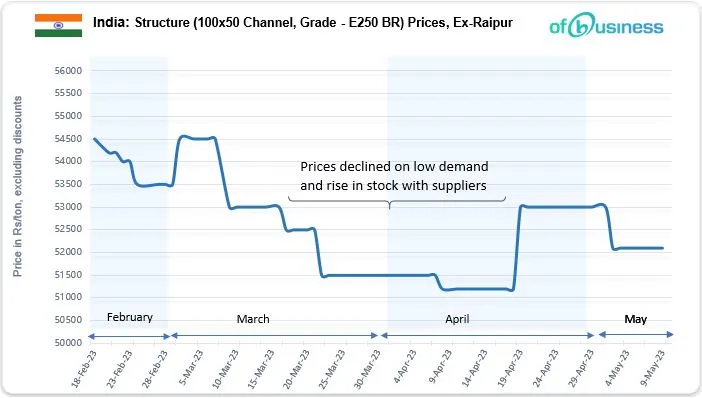
The domestic Structural Steel market has experienced a period of limited support despite demand fluctuations. While the prices of Structural Steel have shown an upward trend due to increased Billet rates, trading activities have remained moderate. In this article, we will dive deep into the Structural Steel market.
Current Scenario
- Increased Semi-Finished Steel Trading- One notable trend in the market has been the significant trading activity in Semi-Finished Steel, including Billets and Sponge Iron. Mills have been observed engaging in bulk buying to restock materials for re-rolling, which has also provided a boost to the Finished Steel segment. However, end consumers have exhibited hesitancy in booking materials at higher rates, resulting in lower booking volumes, sources reported to ofbusiness.
- Price Fluctuation- Despite the recent price increases in Structural Steel, a comparison over the past three weeks reveals a decline in prices across the country, ranging from Rs. 1,000-2,000/ton.
- Primary Mills- Mills offered 100 x 50 Channel at different rates, such as Rs. 55,000/ton in Durgapur, Rs. 58,500/ton in Chennai, and Rs. 57,000/ton in Hyderabad, on an ex-works basis.
- Secondary Re-rolling Mills- Mills have also quoted varying prices 100 x 50 Channel, ranging from Rs. 52,000/ton in Raipur, Rs. 51,500/ton in Raigarh, Rs. 55,300/ton in Chennai, and Rs. 53,200/ton in Hyderabad. These prices exclude trade discounts.
Challenges And Market Dynamics
Given the current market situation, it’s unlikely that demand will improve as prices continue to witness a significant decline. Leading manufacturers like JSPL exert considerable influence and dominate the market, particularly in the heavy section, establishing a virtual monopoly. These market dynamics pose challenges for smaller players in the industry.
OFB’s Insight
The Structural Steel market has shown resilience amidst fluctuating demand, with trading activities remaining moderate. Although prices have increased in the short term, a decline has been observed over the past few weeks. Market participants anticipate further corrections in May 2023. It remains to be seen how the market will adapt to the dominance of key manufacturers and navigate the challenges that lie ahead.
For real time commodity prices, latest news, and insights, please download the all NEW and all FREE OfBusiness APP
Suggested Readings

ISMC Size Chart: MS Channel Weight per Meter, Sizes & Uses
TL;DR: MS channels come in standard ISMC sizes under IS 808, each with a fixed weight per meter that determines load capacity and material cost. ISMC 100 weighs 9.56 kg/m; ISMC 150 weighs 16.80 kg/m; ISMC 200 weighs 22.30 kg/m. This guide covers the full size chart, procurement checklist, and how to source verified MS

MS Angle and Channel: Difference, Sizes & Weight
TL;DR: MS angle is an L-shaped steel section for bracing and light framing. MS channel is a C-shaped section that carries load across a span. Angles cost less to fabricate, while channels resist bending better. They are not interchangeable. This guide compares shape, weight, size, and cost, so fabricators and contractors can pick the right

Steel Beam vs I-Beam: Structural Differences Explained
TLDR: Steel beam vs I-beam is a key comparison in construction, affecting strength, cost, and design. This guide explains structural differences, I-beam vs H-beam, beam dimensions, and standard I-beam sizes with charts. Understand steel beam vs I-beam clearly to choose the right section for better load performance and efficient material use. The comparison between steel