
Surging TMT Prices: What's Behind Sudden Spike In The Domestic Market?
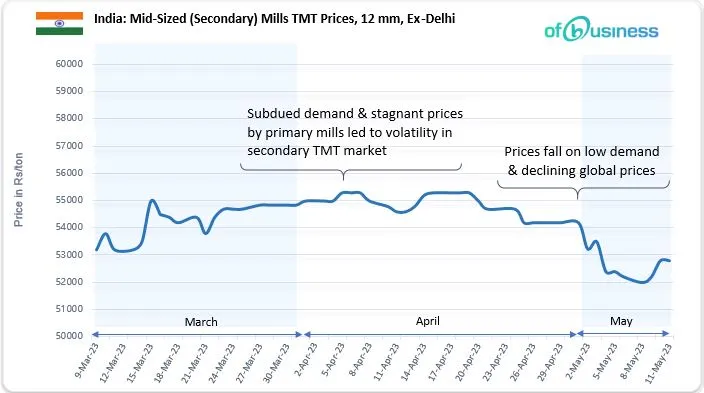
The domestic TMT market has experienced a sudden price surge since Monday (8 May 2023), which has been sustained until now. Despite low to moderate demand, primary mills have managed to maintain stable prices amidst rumors of price corrections for May 2023. This article examines the current state of the TMT market, including the response of manufacturers and the impact on prices.
Current Industry Scenario
- Competing For Orders In Competitive Environment- Manufacturers are actively vying for orders in this highly competitive market. Interestingly, the secondary market has witnessed an upward trend over the past three days, prompting primary manufacturers to stabilize their prices accordingly. This indicates the active competition among manufacturers to secure orders and maintain market share.
- Demand & Raw Material Factors- While demand from the retail sector remains low, the demand for TMT in projects has remained unaffected. Market participants do not anticipate further increases in TMT prices due to weak demand for raw materials in the domestic market. As a result, prices of Iron Ore and Coal have been declining, sources reported to ofbusiness. However, the Finished Steel market has experienced a boom, driven by increased demand for Semi-Finished products like Billets and Sponge Iron. Bulk buying in the Semi-Finished sector has led to price increments.
TMT Prices
- Primary Prices- Primary manufacturers are offering TMT at Rs. 56,500-57,000/ton Ex-Mumbai, Rs. 56,500-57,000/ton Ex-Delhi NCR, and Rs. 54,000-54,500/ton Ex-Vizag.
- Secondary Prices- The secondary TMT prices have seen an increase in the range of Rs. 300-700/ton over the past three days. The current offers stand at Rs. 49,000/ton Ex-Raipur, Rs. 53,500/ton Ex-Hyderabad, and Rs. 53,000/ton Ex-Delhi NCR.
- Meanwhile, the conversion spread from Billet to TMT in Central and Eastern regions is around Rs. 3,500-4,500/ton for secondary segment.
OFB’s Insight
The TMT market has witnessed fluctuating prices in recent days, with primary manufacturers managing to stabilize their prices despite rumors of corrections. The competitive environment has spurred manufacturers to actively compete for orders, resulting in price adjustments in the secondary market. While the demand for raw materials remains weak, the market for Semi-Finished products has experienced growth. As the TMT market continues to evolve, market participants will closely monitor the interplay between supply, demand, and raw material costs to anticipate future price movements.
Read more: Structural Steel Market Faces Challenges Amidst Fluctuations: Find Out What Lies Ahead In May 2023
For real time commodity prices, latest news, and insights, please download the all NEW and all FREE OfBusiness APP
Suggested Readings

ISMC Size Chart: MS Channel Weight per Meter, Sizes & Uses
TL;DR: MS channels come in standard ISMC sizes under IS 808, each with a fixed weight per meter that determines load capacity and material cost. ISMC 100 weighs 9.56 kg/m; ISMC 150 weighs 16.80 kg/m; ISMC 200 weighs 22.30 kg/m. This guide covers the full size chart, procurement checklist, and how to source verified MS

MS Angle and Channel: Difference, Sizes & Weight
TL;DR: MS angle is an L-shaped steel section for bracing and light framing. MS channel is a C-shaped section that carries load across a span. Angles cost less to fabricate, while channels resist bending better. They are not interchangeable. This guide compares shape, weight, size, and cost, so fabricators and contractors can pick the right

Steel Beam vs I-Beam: Structural Differences Explained
TLDR: Steel beam vs I-beam is a key comparison in construction, affecting strength, cost, and design. This guide explains structural differences, I-beam vs H-beam, beam dimensions, and standard I-beam sizes with charts. Understand steel beam vs I-beam clearly to choose the right section for better load performance and efficient material use. The comparison between steel