
Stainless steel is used for food and beverage equipment, chemical tanks and piping, medical instruments, pharma plant equipment, energy and power components, vehicle exhausts and tankers, and construction cladding. It is chosen wherever equipment must resist corrosion, heat or contamination. Grade 304 covers most general uses, and grade 316 covers chemical and marine service.
Metals
What are Stainless Steel Uses in Industrial Manufacturing?
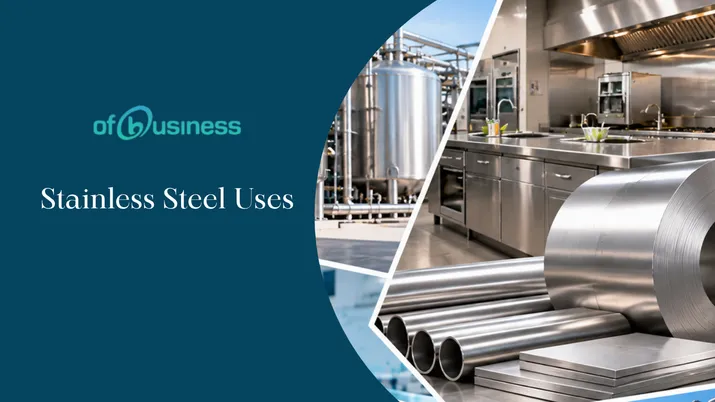
TL;DR: Stainless steel is used in food processing, chemical plants, pharma and medical equipment, energy, transport and construction because chromium forms a self-healing oxide layer that resists rust. This guide maps each industrial use to the right grade and shows what to check before buying, so procurement teams can source verified stainless steel on OFB with confidence.
Stainless steel uses in industrial manufacturing range from food vats to refinery pipework. This guide maps each industry to the grade that suits it, and explains why. It is written for buyers who source stainless steel through OfBusiness (OFB), a B2B industrial procurement platform with verified suppliers.
Table of Contents
What is Stainless Steel?
Stainless steel is an iron-based alloy containing at least 10.5% chromium and a maximum of about 1.2% carbon. The chromium forms a thin oxide layer on the surface. This layer blocks further oxidation and repairs itself when scratched, provided oxygen is present. That is why stainless steel resists rust where carbon steel does not.
Steel itself is an alloy of iron and carbon, with carbon typically below 2%. In trade, stainless steel is shortened to SS, followed by a grade number such as SS 304. The composition of steel and stainless steel differs mainly in chromium, nickel and molybdenum.
| Element | Mild steel | SS 304 | SS 316 |
| Carbon | 0.05–0.25% | up to 0.08% | up to 0.08% |
| Chromium | negligible | 18–20% | 16–18% |
| Nickel | negligible | 8–10.5% | 10–14% |
| Molybdenum | none | none | 2–3% |
| Iron | balance | balance | balance |
Chromium gives corrosion resistance. Nickel adds toughness and formability. Molybdenum improves resistance to pitting in chloride environments. These are typical ranges, so confirm exact values on the Mill Test Certificate.
Read in detail about Stainless Steel
What Are the Main Uses of Stainless Steel in Industrial Manufacturing?
The main uses of stainless steel are food and beverage processing, chemicals, medical and pharma manufacturing, energy, transport and construction. In each case, stainless steel is chosen because equipment must resist corrosion, heat or contamination. The table below shows typical equipment and common grades for each industry.
| Industry | Typical equipment | Common grades | Why stainless steel |
| Food and beverage | Process tanks, vats, pipelines, conveyors, mixers, kitchen equipment | 304, 316 | Non-reactive, non-porous, easy to sanitise |
| Chemical and petrochemical | Reactors, tanks, piping, valves, heat exchangers | 316, duplex | Resists acids, solvents and chlorides |
| Medical and pharma | Instruments, implants, clean-room equipment, autoclaves | 420, 316L | Sterilises repeatedly and suits contact with the body |
| Energy and power | Cooling systems, boiler tubes, solar thermal tanks, downhole tubing | 304, 316, duplex | Handles heat, pressure and corrosion |
| Transport and aerospace | Exhaust systems, trim, tankers, fasteners, hydraulics | 409, 430, 304 | Heat tolerance and durability |
| Construction | Cladding, handrails, lift interiors, roofing | 304, 316 | Weather resistance and low maintenance |
Plain carbon steel still suits jobs where cost matters more than corrosion resistance, such as reinforcement bars and structural sections. OFB’s mild steel guide covers those applications of steel.
Primary Stainless Steel Uses in Manufacturing
Listed below are some of the primary stainless steel uses in manufacturing:
- Food and Beverage Processing
In food manufacturing, hygiene is a non-negotiable metric. Stainless steel dominates here because it is non-reactive and non-porous.
- Hygiene: The smooth surface is easy to sanitise and does not absorb residues.
- Durability: It withstands acidic products like citrus and dairy without leaching.
- Equipment: Process tanks, pasteurisation heat exchangers, pipelines, conveyor belts, mixing blades and brewing vessels all use stainless steel.
- Commercial kitchens: Kitchens with stainless steel appliances, worktables and sinks rely on the same properties.
- Chemical and Petrochemical Industry
The chemical sector needs materials that survive harsh solvents and high pressure.
- Corrosion resistance: Grade 316 is widely used for reactors, storage tanks, pipes and valves, because molybdenum improves resistance to pitting.
- Desalination and water treatment: Seawater chlorides attack lower grades, so 316 and duplex grades are used in desalination plants.
- Refineries: Stability at temperature makes stainless steel a standard choice for pipework under constant thermal stress.
- Medical and Pharmaceutical Manufacturing
Stainless steel suits medicine because it can be sterilised repeatedly and is compatible with the body.
- Surgical tools: Scalpels and forceps use hardenable martensitic grades that hold an edge through repeated sterilisation.
- Implants: Low-carbon 316L is a common choice for implants.
- Pharmaceutical plants: Pill presses, process tanks, autoclaves and clean-room cabinetry use stainless steel to meet strict regulatory standards.
- Energy and Power Generation
The energy sector uses stainless steel to manage heat, pressure and corrosion.
- Nuclear power: It is used in cooling systems and components that contain radioactive material.
- Solar thermal: Tanks and piping handle molten salt at high temperature.
- Oil and gas: Duplex grades in downhole tubing and subsea parts resist sour gas and salt water.
- Power plants: Boiler and heat exchanger tubes use austenitic grades for heat resistance.
- Transportation and Aerospace
Transport uses stainless steel where durability and heat tolerance matter.
- Automotive: Ferritic grades such as 430 are common in exhaust systems and trim, where heat and moisture are constant.
- Tankers: Road tankers for milk and chemicals use stainless steel to keep loads uncontaminated.
- Aerospace: Austenitic grades stay tough at low temperatures, so they suit fasteners and hydraulic components.
- Construction and Architecture
Stainless steel in construction is used for cladding, handrails, lift interiors and roofing, particularly at coastal sites where carbon steel corrodes quickly. Grade 316 is preferred near the sea. Highly corrosive structures may also use stainless steel reinforcement.
Which Stainless Steel Grade Suits Which Use?
Grade 304 suits most food, kitchen and general industrial uses. Grade 316 suits chemical, marine and pharma service, because molybdenum resists chlorides. Ferritic 430 suits appliances and automotive trim, while duplex grades suit desalination and oil and gas. Match the grade to the exposure, not to the price.
| Family | Example grades | Magnetic | Typical use |
| Austenitic | 304, 316, 202 | Generally non-magnetic | Food equipment, tanks, pipes, utensils |
| Ferritic | 430, 409 | Magnetic | Appliances, exhaust systems, trim |
| Martensitic | 410, 420 | Magnetic | Cutlery, surgical instruments, valves |
| Duplex | 2205 | Magnetic | Desalination, oil and gas, chemical plants |
| Precipitation hardening | 17-4 PH | Magnetic | Aerospace parts, high-strength shafts |
Indian standards cover stainless steel by product form. IS 6911 covers plate, sheet and strip, and IS 6603 covers bars and flats. ASTM A240 is the common reference for 304 and 316 plate, sheet and strip in export-linked orders.
What Are the Advantages and Disadvantages of Stainless Steel in Industrial Use?
The main advantages of stainless steel are corrosion resistance, long service life, hygiene and recyclability. The main disadvantages are higher upfront cost, nickel-linked price swings and harder machining. Buyers weigh these against lifetime maintenance savings. Where corrosion is not a risk, carbon steel is often the better choice.
Advantages:
- Resists rust without painting or coating
- Low maintenance, so fewer part replacements
- Fully recyclable at end of life
Disadvantages:
- Higher upfront cost than carbon steel
- Work-hardens, so machining is slower
- Grade 304 can pit in chloride or marine conditions
How to Choose and Buy Stainless Steel for Your Use?
Choosing stainless steel for a specific use takes six steps: define the exposure, pick the grade, fix the form, finish and standard, verify composition, qualify the supplier, and compare quotes on one basis. Most disputes come from grade substitution, such as 202 supplied against a 304 order.
- Define the exposure: food contact, acid, chloride, heat or outdoor weather.
- Pick the grade using the grade-by-use table above.
- Fix the product form, finish and standard in writing, for example 304 sheet, 2B finish, IS 6911.
- Request the Mill Test Certificate and run a positive material identification test on a sample. A magnet is not reliable, since cold-worked 304 can be slightly magnetic.
- Qualify the supplier on BIS documentation and batch test reports.
- Compare quotes on the same basis: ex-factory, ex-warehouse or delivered.
What Determines Stainless Steel Prices in India?
Stainless steel prices in India are driven mainly by nickel and molybdenum costs, then by grade, finish, product form, order volume and region. Nickel is typically the largest cost input in grade 304, so prices follow LME nickel closely. Domestic coil makers revised prices several times between January and May 2026, then prices eased in early July as nickel softened (BigMint).
| Grade | Typical use | Indicative price (per kg) | Basis and date |
| SS 304 | Food equipment, tanks, architecture | ₹180–₹220 | Finished sheets and coils, ex-Mumbai, November 2026 |
| SS 316 | Chemical, marine, pharma | ₹280–₹350 | Finished sheets and coils, ex-Mumbai, November 2026 |
| SS 202 | Utensils, decorative use | ₹140–₹170 | Finished sheets and coils, ex-Mumbai, November 2026 |
How to Procure Stainless Steel Through OFB?
OFB connects industrial buyers with verified suppliers of stainless steel in grades such as 304, 316L, 202 and 430. Listings cover sheets, coils and pipes in finishes including 2B, BA and No.4. Buyers can compare grade-wise rates on one platform instead of negotiating with each supplier separately.
OFB’s supplier network undergoes quality and compliance verification. Confirm individual supplier certifications, including Mill Test Certificates, at the point of order. Large orders can use procurement credit through Oxyzo Financial Services, an RBI-registered NBFC. Delivery timelines are subject to location, order volume and logistics partner availability.
Conclusion
Stainless steel earns its place wherever equipment faces corrosion, heat or hygiene demands. Match the grade to the use, then verify composition on the Mill Test Certificate before ordering. Compare cost over the whole service life, not the first invoice. Explore OFB’s stainless steel category to compare grades from verified suppliers, with procurement credit through Oxyzo for large orders.
Frequently Asked Questions
In heavy industry, SS steel is used for heat exchangers, chemical storage, high-pressure piping and refinery equipment. It keeps its strength and resists corrosion under heat and pressure. Grade 316 and duplex grades are chosen where chlorides or acids are present, such as desalination and chemical plants.
Grade 304 is the standard choice for food processing equipment, including tanks, conveyors and kitchen appliances. Grade 316 is used where products are salty or acidic, or where cleaning chemicals are harsh. Both are non-reactive and easy to sanitise. Confirm FSSAI-related requirements with your equipment supplier.
No. Stainless steel needs at least 10.5% chromium, which forms the protective oxide layer. Mild steel is iron with 0.05–0.25% carbon and negligible chromium. Grade 304 also adds roughly 8–10.5% nickel, and grade 316 adds 2–3% molybdenum.
The advantages of stainless steel are corrosion resistance, low maintenance, hygiene and recyclability. The disadvantages are higher upfront cost, nickel-linked price swings and harder machining. Grade 304 can also pit in chloride environments. In corrosive or hygiene-critical uses, the benefits usually outweigh the extra cost.
Suggested Readings

Metals
MS Angle and Channel: Difference, Sizes & Weight
TL;DR: MS angle is an L-shaped steel section for bracing and light framing. MS channel is a C-shaped section that carries load across a span. Angles cost less to fabricate, while channels resist bending better. They are not interchangeable. This guide compares shape, weight, size, and cost, so fabricators and contractors can pick the right

Metals
ISMC Size Chart: MS Channel Weight per Meter, Sizes & Uses
TL;DR: MS channels come in standard ISMC sizes under IS 808, each with a fixed weight per meter that determines load capacity and material cost. ISMC 100 weighs 9.56 kg/m; ISMC 150 weighs 16.80 kg/m; ISMC 200 weighs 22.30 kg/m. This guide covers the full size chart, procurement checklist, and how to source verified MS
Metals
Steel Beam vs I-Beam: Structural Differences Explained
TLDR: Steel beam vs I-beam is a key comparison in construction, affecting strength, cost, and design. This guide explains structural differences, I-beam vs H-beam, beam dimensions, and standard I-beam sizes with charts. Understand steel beam vs I-beam clearly to choose the right section for better load performance and efficient material use. The comparison between steel

