
Are There Opportunities For Indian Maize Market Amidst Ongoing Global Challenges?
Maize, also known as corn, is a staple crop that plays a vital role in the global food supply chain. Having said that, the maize market is susceptible to various factors that can influence prices and availability, making it important to keep up with the latest trends and issues. In this article, we’ll explore some of the current happenings in the maize market and how they can impact India.
Struggling Global Maize Industry
- Climate Change Challenges For US Maize Market– The United States, one of the largest maize producers in the world, is facing climate change-related issues that have disrupted maize production. Extreme weather events such as droughts, floods, and heat waves have led to lower yields, increasing the cost of maize, and affecting food security. As a result, the US government has implemented policies to tackle the issue and support farmers, to increase maize production and ensure food availability.
- Drought In Argentina- Argentina is another major maize producer that has been affected by a severe drought, which is expected to impact soybean and maize production. This can lead to a decrease in the global maize supply, resulting in higher prices and potential shortages. The situation in Argentina highlights the need for sustainable farming practices and climate-resilient crops that can adapt to changing weather patterns.
- Geopolitical Tensions And Ukrainian Maize Exports– The ongoing conflict between Ukraine and Russia has raised concerns over maize exports from Ukraine, a significant maize-producing country. Russia can dismiss the Black Sea grain deal at any time, leading to a reduction in maize exports from Ukraine. This can disrupt the global maize market, causing prices to rise and supply shortages.
Growth Opportunities
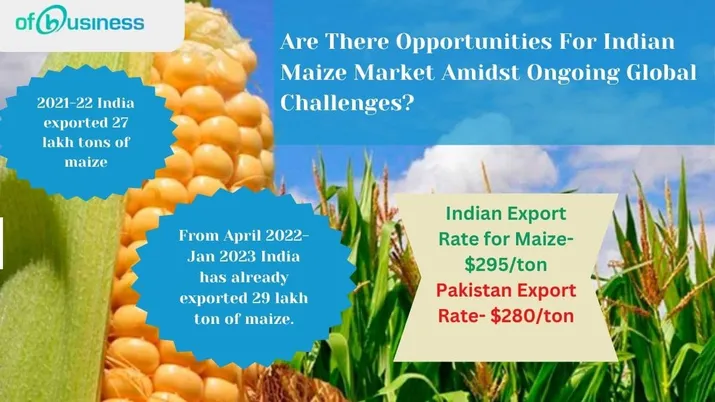
- Increasing Global Demand For Maize From India– The demand for maize is growing globally, presenting an opportunity for countries like India to export more maize. In the 2021-22 season, India exported 27 lakh tons of maize, and within ten months of 2022-23 (April 2022 to January 2023), India has already exported 29 lakh tons. This trend is positive for the Indian maize market and can help increase the country’s agricultural exports.
- Competition From Emerging Competitors– While India is experiencing growth in maize exports, it faces stiff competition from emerging competitors like Pakistan. Pakistan is trading at a lower export price of $280/ton compared to India’s $295/ton, making it challenging for India to compete in the international market. However, the quality of Pakistani maize is reportedly inferior, giving India an advantage in the long run.
- Bihar’s Increased Maize Arrival- There a good news for the maize market in India- Bihar, a maize-producing state in India, has experienced an increase in maize arrival, which is a positive development for the Indian maize market. This can help increase the supply of maize, leading to lower prices and more exports. Additionally, Bihar’s focus on sustainable farming practices can help address environmental issues related to maize production.
OFB’s Insight
The maize market is influenced by various factors, including climate change, geopolitical tensions, and increasing demand. Keeping up with the latest trends and issues can help stakeholders navigate challenges and opportunities in the maize market. From the challenges faced by major producers like the US and Argentina to the opportunities presented by increasing global demand, the maize market continues to evolve and impact the global food supply chain. India is immune to these challenges at present.
For real time commodity prices, latest news, and insights, please download the all NEW and all FREE OfBusiness APP.
Suggested Readings
Parmal Rice vs Basmati Rice – Nutrition, GI and Health Benefits of Indian Varieties
TL;DR: Parmal rice is a non-aromatic, protein-rich variety from Punjab and Haryana with a low glycemic index — making it a practical choice for everyday health-conscious consumption. Basmati offers balanced amino acids, superior aroma, and a medium GI. Indrayani supports digestive health and carries a medium GI. This guide covers the nutritional profiles and GI
Edible Oil Importers in India: Duties, Supply and Industry Outlook
TL;DR: India’s vegetable oil imports fell 29% year-on-year in June 2026, but cumulative imports between November 2025 and June 2026 remained 6% higher. Lower domestic stocks, slower oilseed crushing and festive-season demand may support stronger imports in the coming months. Palm oil remains India’s largest imported edible oil, while India soybean oil imports have increased
8 Products Extracted From Sugarcane (Apart From Sugar And Ethanol)
Sugarcane is an incredibly versatile crop, there is a reason why it has been cultivated for thousands of years. It's one of the most popularly cultivated crops across the world, with over 80 countries cultivating it. Part of the reason for its success is its vast array of products that are made from sugarcane. Sugar and ethanol are two products derived from sugarcane and these two products are well known. But that’s not it. There are other products derived from sugarcane as well. In this article, we will describe other derived products derived from sugarcane as well.