
A: White sugar is made by crushing sugarcane to extract juice, clarifying that juice, evaporating excess water and concentrating it into syrup. The syrup is crystallised, and centrifuges separate the sugar crystals from molasses. The crystals are subsequently dried, cooled, graded and packed.
Processed Food
How White Sugar Is Made in India: Sugar Manufacturing Process?
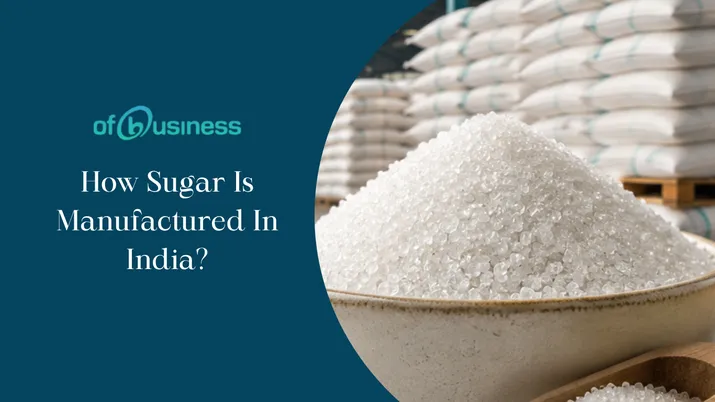
TL;DR: White sugar is made in India by crushing prepared sugarcane to extract juice, clarifying the juice, evaporating excess water, forming sugar crystals and separating them in centrifuges. The crystals are then dried, graded and packed. Bagasse, molasses and press mud generated during processing can also be used in other industrial applications.
White sugar is made in India by extracting juice from sugarcane, removing impurities, concentrating the juice into syrup, crystallising sucrose and separating the crystals from molasses. The sugar is then dried, graded and packed. This step-by-step sugar making process in India is generally carried out in large sugar mills using continuous industrial equipment.
For industrial buyers, food processors and businesses sourcing sugar, understanding these stages helps explain differences in sugar type, crystal size, colour and processing quality.
Table of Contents
Sugar Making Process in India: Step-by-Step Overview
The production of sugar from sugarcane follows a sequence of mechanical and thermal operations.
| Stage | What happens |
|---|---|
| Cane receiving | Sugarcane arrives at the mill and is weighed |
| Cane preparation | Cane is cut and shredded before crushing |
| Juice extraction | Milling or crushing separates juice from bagasse |
| Juice clarification | Suspended matter and impurities are removed |
| Evaporation | Water is removed to produce concentrated syrup |
| Crystallisation | Sugar crystals are formed under controlled conditions |
| Centrifugation | Crystals are separated from molasses |
| Drying and grading | Sugar is dried, screened and classified |
| Packing | Finished sugar is packed for storage or dispatch |
An official Department of Food and Public Distribution process flow similarly shows cane weighing, unloading, milling, clarification, evaporation, vacuum-pan processing, crystallisation and centrifugation before the final sugar stage.
1. Sugarcane Delivery and Weighing
The sugar manufacturing process in India begins when harvested sugarcane reaches the sugar mill.
Cane may arrive through trucks, tractors and other transport systems depending on the producing region and mill infrastructure.
At the factory, the sugarcane is weighed before unloading. Accurate weighing is important because mills use cane quantity as part of their production and farmer-payment records.
The cane then moves towards the preparation and milling section.
2. Sugarcane Preparation
Before juice can be extracted efficiently, the cane must be broken into smaller pieces.
Industrial sugar mills use cane cutters, knives and shredders to open the stalk structure. This creates a more uniform material for the milling equipment.
Effective preparation increases the surface area available for juice extraction and helps the crushing system process the cane consistently.
3. Sugar Juice Extraction
Prepared sugarcane passes through a series of heavy rollers or milling units that squeeze out the juice.
The liquid extracted during this stage contains water, sucrose and several non-sugar components.
The fibrous material remaining after juice extraction is called bagasse.
Many integrated sugar mills use bagasse as fuel in boilers for steam and power generation. The Government of India’s integrated sugar-mill flow diagram shows bagasse moving from cane milling towards cogeneration and boiler operations.
What happens to the remaining sugar in the bagasse?
Mills can use an extraction technique known as imbibition, where water is introduced during milling to recover additional soluble sugar from the fibrous cane material.
The extracted juices are then collected and sent for clarification.
4. Sugar Juice Clarification
Freshly extracted cane juice contains suspended solids, fibres and other non-sugar materials. These need to be reduced before the juice is concentrated.
During clarification, the juice is treated and heated under controlled conditions. The objective is to separate impurities while retaining as much recoverable sucrose as possible.
Sulphitation-based clarification has historically been associated with plantation white sugar production in Indian mills. The exact treatment system, however, can vary by plant and the type of sugar being produced.
The clarified juice then moves to the evaporation stage.
5. Sugar Juice Evaporation
Clarified cane juice still contains a large quantity of water.
Evaporators remove much of this water and gradually concentrate the juice into a thick syrup.
Industrial mills commonly use multiple-stage evaporation systems to recover heat efficiently while increasing the concentration of dissolved solids.
The Government of India’s integrated mill process also places evaporators between juice treatment and the later sugar-crystallisation stages.
6. Sugar Crystallisation
The concentrated syrup is then processed so that sucrose begins forming crystals.
This usually takes place under controlled vacuum conditions. Reducing pressure allows concentration and crystallisation to occur at lower boiling temperatures than would otherwise be required.
The syrup is further concentrated until sugar crystals form within the liquid mixture.
This mixture of crystals and surrounding syrup is commonly referred to as massecuite.
7. Centrifugation: Separating Sugar from Molasses
The massecuite enters a centrifuge, which spins rapidly to separate sugar crystals from the surrounding liquid.
The heavier sugar crystals remain within the centrifuge basket while the liquid portion is separated.
That liquid contains molasses and residual sugars.
The official integrated sugar-mill flow chart identifies centrifugation as the final separation stage before sugar emerges as the main product. It also shows molasses as an important side stream from the process.
8. Sugar Drying and Cooling
Freshly separated sugar crystals still retain surface moisture.
The crystals are therefore dried and cooled before storage. Controlled drying reduces moisture and helps maintain the physical condition of the sugar during handling and transportation.
After cooling, the sugar is ready for grading.
9. Grading, Storage and Packing
Finished sugar is screened according to the required crystal-size specification and quality parameters.
It is then transferred to storage systems or packed for dispatch.
Different buyers may require different sugar specifications depending on their application. Large food processors, beverage manufacturers, confectionery businesses and institutional buyers may evaluate factors such as:
- Sugar type
- Crystal size
- Colour
- Moisture
- Sucrose content
- Packaging format
- Batch consistency
- Applicable quality and food-safety requirements
The Sugar (Control) framework in India recognises different forms of sugar, including raw, plantation white and refined sugar.
What Are the Main By-Products of Sugar Manufacturing?
Sugar manufacturing produces several commercially useful by-products alongside crystalline sugar.
Bagasse
Bagasse is the fibrous material left after juice extraction.
Sugar mills can use it as a boiler fuel for generating steam and electricity. Surplus bagasse can also have other industrial uses.
Molasses
Molasses is the sugar-rich liquid remaining after crystal separation.
It is an important feedstock for distillery operations and can be used in ethanol and other fermentation-based processes.
Press Mud
Clarification also produces a solid residue commonly called press mud or filter cake.
It can have agricultural and other downstream applications depending on processing and quality.
The Department of Food and Public Distribution’s integrated mill flow shows bagasse feeding cogeneration, press mud moving towards agricultural use, and molasses feeding distillery operations.
How Is White Sugar Made in India?
White sugar in India is produced by extracting juice from sugarcane, clarifying it to reduce impurities, evaporating water to create concentrated syrup and crystallising the sucrose. Centrifuges then separate the sugar crystals from molasses. Finally, the crystals are dried, cooled, graded and packed.
In simple terms:
Sugarcane → Preparation → Crushing → Juice → Clarification → Evaporation → Crystallisation → Centrifugation → Drying → White Sugar
This process answers the core question of how white sugar is made in India without treating sugar production as a single crushing or boiling operation.
Why Sugar Mill Integration Matters?
Modern sugar mills can function as more than standalone sugar-production facilities.
The same sugarcane can create several output streams. Sugar remains the primary product, while bagasse can support energy generation and molasses can feed distillery operations.
This integrated model allows more of the sugarcane biomass to enter productive uses instead of treating every non-sugar output as waste. India’s Department of Food and Public Distribution illustrates these linked sugar, cogeneration and distillery pathways in its integrated mill process model.
Conclusion
The sugar making process in India converts harvested sugarcane into crystalline sugar through a controlled series of extraction, purification, concentration and separation stages.
For industrial buyers, understanding how white sugar is made in India provides useful context when evaluating sugar specifications, consistency and supplier capabilities.
Frequently Asked Questions
A: The sugar making process in India generally includes cane receiving, preparation, juice extraction, clarification, evaporation, crystallisation, centrifugation, drying, grading and packing. Integrated mills may also use bagasse for energy generation and molasses as a feedstock for distillery operations.
Suggested Readings
Processed Food
Parmal Rice vs Basmati Rice – Nutrition, GI and Health Benefits of Indian Varieties
TL;DR: Parmal rice is a non-aromatic, protein-rich variety from Punjab and Haryana with a low glycemic index — making it a practical choice for everyday health-conscious consumption. Basmati offers balanced amino acids, superior aroma, and a medium GI. Indrayani supports digestive health and carries a medium GI. This guide covers the nutritional profiles and GI

Processed Food
Edible Oil Importers in India: Duties, Supply and Industry Outlook
TL;DR: India’s vegetable oil imports fell 29% year-on-year in June 2026, but cumulative imports between November 2025 and June 2026 remained 6% higher. Lower domestic stocks, slower oilseed crushing and festive-season demand may support stronger imports in the coming months. Palm oil remains India’s largest imported edible oil, while India soybean oil imports have increased
Processed Food
8 Products Extracted From Sugarcane (Apart From Sugar And Ethanol)
Sugarcane is an incredibly versatile crop, there is a reason why it has been cultivated for thousands of years. It's one of the most popularly cultivated crops across the world, with over 80 countries cultivating it. Part of the reason for its success is its vast array of products that are made from sugarcane. Sugar and ethanol are two products derived from sugarcane and these two products are well known. But that’s not it. There are other products derived from sugarcane as well. In this article, we will describe other derived products derived from sugarcane as well.

