
Is There A Need For Change In Minimum Support Price System In India?
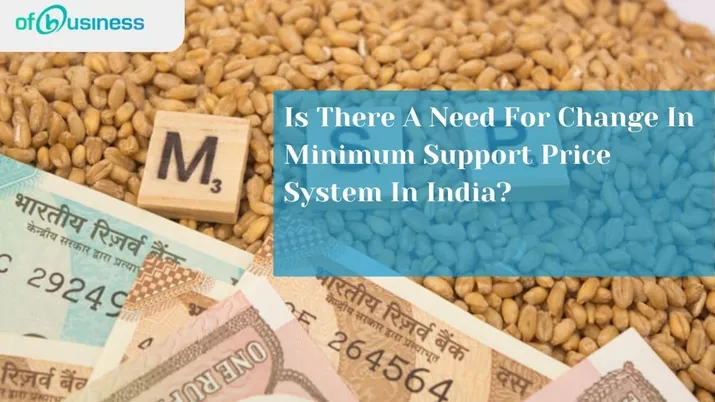
To safeguard the interests of farmers and minimize their losses in case of a fall in crop prices, the Minimum Support Price (MSP) system in India was introduced. The MSP is based on various factors such as production cost, demand and supply position, market prices, variable costs, and international market prices. However, the policy needs to be updated to benefit farmers better. In this article, we will explore the basics of the current MSP system and the ways how it can be improved so that farmers’ interests can be safeguarded to a certain extent.
MSP: An Overview
Here’s an overview of the current MSP system and the suggestive changes to make it even better:
- State-Wise Crops Cost Variation
The crop cultivation cost varies from state to state in India. The Minimum Support Price for a crop is established after the Commission for Agricultural Costs and Prices (CACP) aggregates the cost price of several regions for that crop. However, this method fails to consider the actual cultivation cost in a particular region. For instance, the total cost of paddy cultivation over a hectare is Rs 90,303 in Andhra Pradesh, Rs 78,429 in Uttar Pradesh, and Rs 67,073 in Punjab. The MSP, in this case, is fixed based on the average cost, which is unfair to farmers in regions where the actual cost of cultivation is higher.
- Agricultural Wage Rate And MSP
State-to-state differences in the agriculture wage rate are significant. However, the average agricultural pay rate of just Rs 190.78 was added when the CACP established the Minimum Support Price of Kharif crops in the calendar year 2019–20. This addition is insignificant when compared to the actual cost of cultivation, which includes labour expenses. The MSP must reflect the actual cost of production, including labour expenses, to benefit farmers.
- State Government’s Role In MSP
According to the Constitution of India, agriculture is a matter of the state list. Even state governments have the authority to raise the Minimum Support Price. However, the central government buys crops only at its fixed MSP. If the state government increases the MSP of a crop, which we call bonuses, the central government buys that crop only at its fixed MSP. This policy restricts state governments from supporting farmers and offering better MSP, leading to losses for the state governments and farmers.
- MSP’s Implication On Farmers
The current Minimum Support Price policy fails to protect the interests of farmers. It results in the state governments incurring losses. The policy is also wheat and paddy-dominated, which affects crop diversity and nutrition security. The MSP must be more than just a procurement price. In simple words, it must be an incentive price for farmers to grow crops that are desirable for nutrition security. A step in the right direction to invest is to incentivize the private sector to form efficient value chains on the basis of a cluster approach. A deficiency payments system could be one way to achieve the goal of having agricultural pricing that is both state-supported and partially market-driven.
Insight
The Minimum Support Price system in India needs to be revisited to benefit farmers in a better way. The price system must consider the actual cost of cultivation, including labour expenses, and should incentivize farmers to grow crops that are desirable for nutrition security. The policy must also allow state governments to increase the MSP without incurring losses and restricting farmers from receiving better rates. It is time to adopt a policy that reflects the changing dynamics of agriculture and the needs of the farming community.
Read more: What Are The Challenges Of The Edible Oil Industry in India?
For real time commodity prices, latest news, and insights, please download the all NEW and all FREE OfBusiness APP.
Suggested Readings
Parmal Rice vs Basmati Rice – Nutrition, GI and Health Benefits of Indian Varieties
TL;DR: Parmal rice is a non-aromatic, protein-rich variety from Punjab and Haryana with a low glycemic index — making it a practical choice for everyday health-conscious consumption. Basmati offers balanced amino acids, superior aroma, and a medium GI. Indrayani supports digestive health and carries a medium GI. This guide covers the nutritional profiles and GI
Edible Oil Importers in India: Duties, Supply and Industry Outlook
TL;DR: India’s vegetable oil imports fell 29% year-on-year in June 2026, but cumulative imports between November 2025 and June 2026 remained 6% higher. Lower domestic stocks, slower oilseed crushing and festive-season demand may support stronger imports in the coming months. Palm oil remains India’s largest imported edible oil, while India soybean oil imports have increased
8 Products Extracted From Sugarcane (Apart From Sugar And Ethanol)
Sugarcane is an incredibly versatile crop, there is a reason why it has been cultivated for thousands of years. It's one of the most popularly cultivated crops across the world, with over 80 countries cultivating it. Part of the reason for its success is its vast array of products that are made from sugarcane. Sugar and ethanol are two products derived from sugarcane and these two products are well known. But that’s not it. There are other products derived from sugarcane as well. In this article, we will describe other derived products derived from sugarcane as well.