
Mustard, Soyabean, & Soyabean Oil Weekly Performance Unveiled
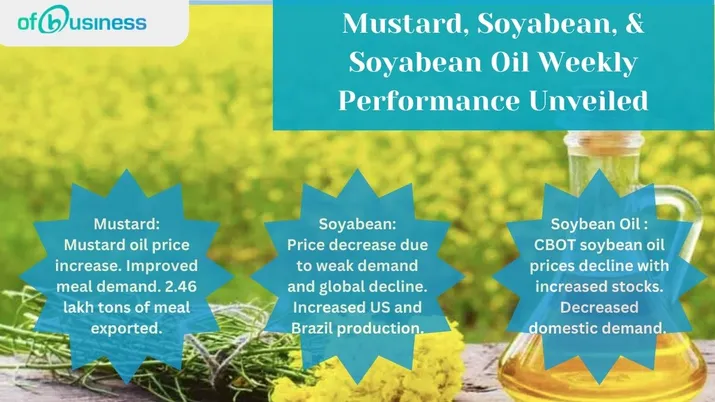
In this week’s market update, let’s delve into the latest performance of three key oil & oilseed commodities: mustard, soybean, and soybean oil from 15 May 2023- 21 May 2023. The mustard market experienced stable prices with limited demand and export demand-induced price increases. Soybean prices decreased due to weak demand and global factors. Soybean oil prices were impacted by weak global markets and domestic demand. Let’s discuss the market performance and outlook in detail:
Mustard
- Performance- Last week, the mustard market saw stable rates and limited demand for plant balls. Despite a decline in international markets, mustard oil experienced a price increase of 2-3 rupees/ kilogram in India. Additionally, there was an improvement in mustard meal demand, leading to an increase in mustard seed prices. India’s strong export demand resulted in the export of 2.46 lakh tons of mustard meal in April 2023. Mustard prices in Jaipur remained relatively stable, while Saloni’s rates saw an increase of 100 rupees/ quintal. However, government procurement through NAFED has been slow, and processors are hesitant to procure mustard at high prices due to significant imports of cheaper foreign oil.
- Outlook– It is expected that mustard prices will fluctuate between a decrease of 100-150 and an increase of 200-250 in the next 10-15 days for trading purposes. These fluctuations will be influenced by various factors such as market demand, international trends, and government interventions. Traders and investors should closely monitor these developments to make informed decisions and avoid excessive stockpiling based on short-lived price surges.
Soybean
- Performance- Previous week, the soybean market saw a decrease in prices because of weak demand for plant balls and a continued decline in global markets. Increased production in the United States and Brazil, along with sufficient supplies in importing countries, put pressure on soybean prices. Furthermore, the United States Department of Agriculture (USDA) raised its soybean production estimates and weakened demand from China led to a weekly decrease of 8.90% in CBOT soybean prices. Farmers and stockists currently have ample soybean supplies, which is expected to be more than sufficient for the next five months. With higher prices of Indian soybean meal compared to other countries, the demand for Indian soybean meal is expected to weaken in the coming months.
- Outlook- In the next 10-15 days, soybean prices are not expected to increase by more than 150-200 rupees. The market will be influenced by factors such as monsoon delays, weather conditions after sowing, and the overall demand for soybean meal. Traders and investors must consider these factors and assess market conditions before making any significant trading decisions.
Soybean Oil
- Performance- Last week saw a decline of more than 4% in CBOT soybean oil prices due to increased stocks in the United States and Argentina. The weakened global market and reduced domestic demand resulted in a decrease in the price of soybean oil by 4 rupees per kilogram. The landing costs and the depreciation of the Indian Rupee provided some support to the sentiment of soybean oil, but soybean oil imports have now ceased.
- Outlook– The upcoming week could see some gains in foreign markets, which may lead to a temporary recovery in soybean oil prices in the domestic market as well. However, it is important to note that this upward momentum may not be sustained. Traders should focus on trading based on their specific requirements and avoid excessive stockpiling based on short-lived price surges. The market conditions should be closely monitored to make informed decisions and minimize risks associated with market volatility.
OFB’s Insight
The mustard market witnessed stable rates with limited demand, while soybean prices experienced a decrease due to weak demand and global factors. Despite the decline in international markets, mustard oil saw a price increase, and there was an improvement in the demand for mustard meals. India’s strong export demand for mustard meals contributed to increased prices of mustard seeds. However, government procurement of mustard has been slow, and processors are cautious due to significant imports of cheaper foreign oil. Mustard prices are expected to fluctuate in the next 10-15 days, and soybean prices are not anticipated to increase significantly. The soybean oil market may experience a temporary recovery based on gains in foreign markets, but sustained upward momentum is uncertain.
Read more: Turkey Extends Russia-Ukraine Grain Export Agreement, Clearing Path For Trade Operations
For real time commodity prices, latest news, and insights, please download the all NEW and all FREE OfBusiness APP.
Suggested Readings
Parmal Rice vs Basmati Rice – Nutrition, GI and Health Benefits of Indian Varieties
TL;DR: Parmal rice is a non-aromatic, protein-rich variety from Punjab and Haryana with a low glycemic index — making it a practical choice for everyday health-conscious consumption. Basmati offers balanced amino acids, superior aroma, and a medium GI. Indrayani supports digestive health and carries a medium GI. This guide covers the nutritional profiles and GI

Edible Oil Importers in India: Duties, Supply and Industry Outlook
TL;DR: India’s vegetable oil imports fell 29% year-on-year in June 2026, but cumulative imports between November 2025 and June 2026 remained 6% higher. Lower domestic stocks, slower oilseed crushing and festive-season demand may support stronger imports in the coming months. Palm oil remains India’s largest imported edible oil, while India soybean oil imports have increased

8 Products Extracted From Sugarcane (Apart From Sugar And Ethanol)
Sugarcane is an incredibly versatile crop, there is a reason why it has been cultivated for thousands of years. It's one of the most popularly cultivated crops across the world, with over 80 countries cultivating it. Part of the reason for its success is its vast array of products that are made from sugarcane. Sugar and ethanol are two products derived from sugarcane and these two products are well known. But that’s not it. There are other products derived from sugarcane as well. In this article, we will describe other derived products derived from sugarcane as well.