
Soybean Market Surges As Demand Increases Amidst Unfavorable Weather
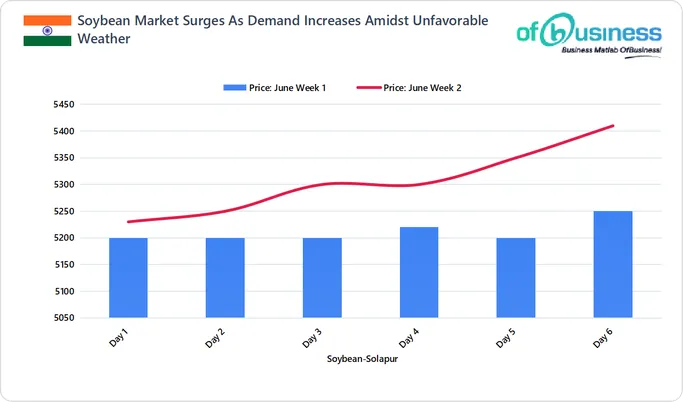
Driven by strong demand and unfavourable weather conditions, the soybean market witnessed a significant price rise last week. This price surge is expected to continue in the coming weeks, making it crucial for traders and farmers to approach the market with caution.
Current Scenario
Let’s explore the current soybean market scenario:
- Demand & Price Increase– Throughout the week, there was a growing soybean demand, resulting in a substantial increase of 150 rupees per quintal. The delayed monsoon and favourable international market conditions played a crucial role in boosting the soybean market. The increasing soybean oil demand in the domestic market also contributed to the price surge.
- Soybean Sowing– As of 16 June 2023, soybean sowing has been completed on 21,000 hectares, which is significantly lower compared to the sowing of 68,000 hectares in 2022. This decline can be attributed to below-average rainfall in soybean-producing regions and dry weather conditions in the United States.
- Weather Conditions– The weather department predicts that dry conditions will persist for the next 15 days. Weather experts believe that the unfavourable weather will continue for the next three months, keeping CBOT soybean futures strong. These conditions indicate that soybean prices are likely to increase further in the coming weeks.
- Soybean Meal Exports– Indian soybean meal price remains higher than that of the international market, impacting the soybean meal export demand. This price disparity poses a challenge for exporters and needs to be monitored closely.
Market Outlook
Currently, soybean sowing is still in its initial phase, and the monsoon is weak. This implies that there is not much downward pressure on soybean prices, and unless normal rainfall occurs, soybean prices may witness a further increase of 150-200 rupees until July week 1.It is important to note that there is an abundant soybean stock available. Therefore, traders and farmers should exercise caution and avoid selling their produce hastily during this surge. Careful consideration of market conditions and an assessment of long-term trends would be prudent to make informed decisions.
OFB’s Insight
The soybean market experienced a significant price rise due to strong demand and unfavourable weather conditions. The surge is expected to continue, but with abundant stock available, it is crucial for market participants to approach the situation with caution and avoid making hasty decisions. Monitoring weather conditions and international market dynamics will be essential in navigating the soybean market in the coming weeks.
Read more: Weekly Update: Wheat Market Performance And Price Control Measures
For real time commodity prices, latest news, and insights, please download the all NEW and all FREE OfBusiness APP.
Suggested Readings
Parmal Rice vs Basmati Rice – Nutrition, GI and Health Benefits of Indian Varieties
TL;DR: Parmal rice is a non-aromatic, protein-rich variety from Punjab and Haryana with a low glycemic index — making it a practical choice for everyday health-conscious consumption. Basmati offers balanced amino acids, superior aroma, and a medium GI. Indrayani supports digestive health and carries a medium GI. This guide covers the nutritional profiles and GI

Edible Oil Importers in India: Duties, Supply and Industry Outlook
TL;DR: India’s vegetable oil imports fell 29% year-on-year in June 2026, but cumulative imports between November 2025 and June 2026 remained 6% higher. Lower domestic stocks, slower oilseed crushing and festive-season demand may support stronger imports in the coming months. Palm oil remains India’s largest imported edible oil, while India soybean oil imports have increased

8 Products Extracted From Sugarcane (Apart From Sugar And Ethanol)
Sugarcane is an incredibly versatile crop, there is a reason why it has been cultivated for thousands of years. It's one of the most popularly cultivated crops across the world, with over 80 countries cultivating it. Part of the reason for its success is its vast array of products that are made from sugarcane. Sugar and ethanol are two products derived from sugarcane and these two products are well known. But that’s not it. There are other products derived from sugarcane as well. In this article, we will describe other derived products derived from sugarcane as well.