
Weak Monsoon Concerns Raise Pulses And Vegetable Prices In India
After two years of relatively good rainfall, the possibility of a weak monsoon seems concerning. This has led to fears of food price inflation, including pulses and vegetables. Pune and other regions in the country have experienced a consistent price increase. If the monsoon turns out to be weak, these prices are expected to rise even further. Let’s explore more about the same:
Sluggish Monsoon’s Impact
The delay in the southwest monsoon in Kerala indicates that vegetable prices may increase. Monsoon’s slow progress has resulted in insufficient rainfall, affecting agriculture, and potentially leading to reduced vegetable supply and higher prices.
Pulses Prices Surge
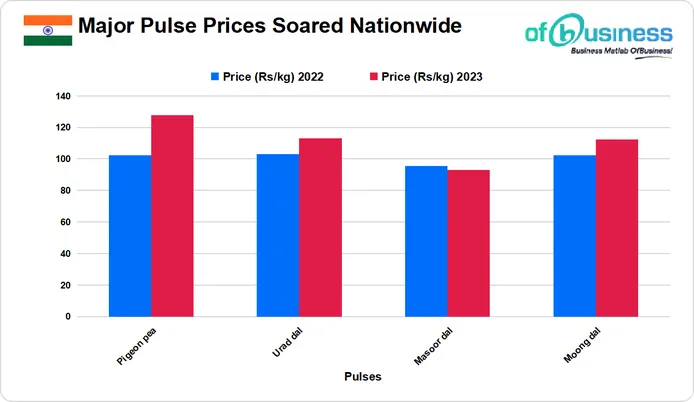
Pulse prices have soared nationwide, the Price Monitoring Cell of the Department of Consumer Affairs acknowledges the substantial price rise across all pulses and lentils and is taking measures to control the situation. Here are the latest prices across India:
- Moong Dal- It is currently between Rs 110/kg-Rs 115/kg, up from Rs 100/kg to Rs 105/kg last year.
- Toor Dal– It has experienced the most significant price increase. Its open market retail price now stands between 125.90-130 rupees per kilogram nationwide, compared to 100 – 105 rupees per kilogram in 2022.
- Urad Dal- It is between Rs 111- Rs 115 per kilogram, compared to Rs 101.24- Rs 105 per kilogram in 2022.
- Masoor Dal- It experienced a slight correction in the year-on-year price and is being sold between Rs 92/kg- Rs 94/kg against between Rs 95/kg-Rs 96/kg last year.
Pune’s Localized Impact
As wholesalers reported a pre-existing price rising trend in the pulse and lentil market even before the monsoon worsened, Pune, Maharashtra, presents a different scenario. Pigeon pea and urad dal prices are already higher than usual, and any potential price softening is contingent upon a supply increase.
Retail Prices
Here are the latest dal prices in Pune:
- Moong Dal– Around 100-110 rupees per kilogram.
- Urad Dal- Around 100-110 rupees per kilogram.
- Masoor Dal– Approx 70-75 rupees per kilogram.
- Toor Dal- Approx Rs 140- Rs 150 per kilogram.
Note- Pulses market supply has decreased by approximately 30%, exacerbating the price surge.
OFB’s Insight
The steady pulse prices rise is alarming. The possibility of poor monsoon adds to the worries, as it may further increase the inflationary pressure on food prices. If the monsoon fails to deliver sufficient rainfall, the pulses and other essential commodities prices are likely to rise even higher.
Read more: India’s Domestic Soybean Production Surge Set To Reduce Imports
For real time commodity prices, latest news, and insights, please download the all NEW and all FREE OfBusiness APP.
Suggested Readings
Parmal Rice vs Basmati Rice – Nutrition, GI and Health Benefits of Indian Varieties
TL;DR: Parmal rice is a non-aromatic, protein-rich variety from Punjab and Haryana with a low glycemic index — making it a practical choice for everyday health-conscious consumption. Basmati offers balanced amino acids, superior aroma, and a medium GI. Indrayani supports digestive health and carries a medium GI. This guide covers the nutritional profiles and GI
Edible Oil Importers in India: Duties, Supply and Industry Outlook
TL;DR: India’s vegetable oil imports fell 29% year-on-year in June 2026, but cumulative imports between November 2025 and June 2026 remained 6% higher. Lower domestic stocks, slower oilseed crushing and festive-season demand may support stronger imports in the coming months. Palm oil remains India’s largest imported edible oil, while India soybean oil imports have increased
8 Products Extracted From Sugarcane (Apart From Sugar And Ethanol)
Sugarcane is an incredibly versatile crop, there is a reason why it has been cultivated for thousands of years. It's one of the most popularly cultivated crops across the world, with over 80 countries cultivating it. Part of the reason for its success is its vast array of products that are made from sugarcane. Sugar and ethanol are two products derived from sugarcane and these two products are well known. But that’s not it. There are other products derived from sugarcane as well. In this article, we will describe other derived products derived from sugarcane as well.