
Downward Price Trend Continues: When Will Be The Right Time To Buy Finished Long Steel Products?
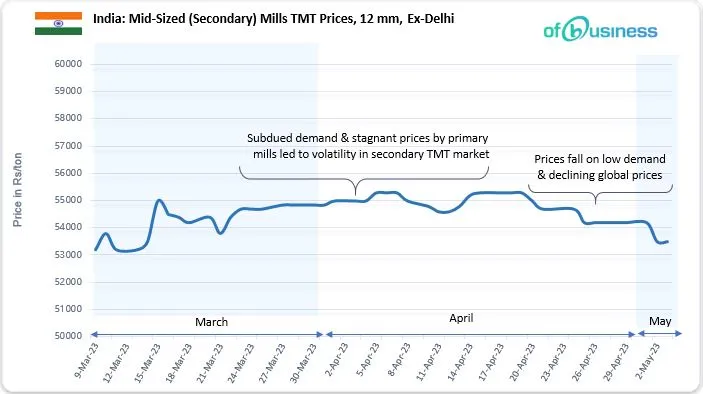
The beginning of May 2023 saw the Finished Long Steel market in India continue to experience a downward trend. TMT and Wire Rod prices were impacted, leading to a drop of up to Rs. 1,900/ton within a week. The primary TMT market remained slow with limited inquiries, while major mills maintained steady prices. Distributors were waiting for primary mills’ TMT price revisions and eyeing a price correction of around Rs. 1,000/ton this month, industry sources reported to Ofbusiness. In this article, we will explore why the market is lackluster and when will be the right time for buying long steel products in India.
Reasons Behind Price Drop
- Raw Material Prices Impact Domestic Market- The raw material prices of Iron Ore and Coal are losing support in the international market due to limited demand and oversupply concerns. This has impacted the Indian domestic market, driving down Finished Long Steel prices. Distributors and traders are focused on clearing available stock by giving more discounts.
- Wait-And-Watch Approach- The overall trend for Finished Long Steel remains lackluster, with buyers adopting a wait-and-watch approach. In the past seven days, the secondary TMT market experienced an overall downfall of around Rs. 1,000-1,300/ton pan India. Secondary Wire Rod prices plunged up to Rs. 1,900/ton to Rs. 48,800/ton ex-Raipur and ex-Durgapur, respectively.
- Price Corrections- Mid-sized mills are offering TMT at Rs. 51,000-51,300/ton ex-Raipur (down by Rs. 1,000/ton), and Rs. 52,400/ton ex-Delhi NCR (down by Rs. 1,800/ton). A drop of Rs. 1,000/ton was observed in Jalna, Maharashtra, to around Rs. 53,500-53,700/ton, while in Hyderabad, a price correction of Rs. 1,200/ton was noticed to Rs. 52,800-53,200/ton. All prices are on an ex-plant basis, excluding GST.
OFB’s Insight
The Finished Long market in India is currently witnessing a decline in TMT and secondary Wire Rod prices. A less supported market has resulted in cautious and need-based purchasing. Traders and distributors are offering more discounts to clear their stocks. Market participants are eyeing primary mills’ price revision announcements for May 2023 so that they can buy Finished Long products, as prices are anticipated to reduce further due to sluggish trends and subdued demand.
Read more: NMDC Iron Ore Output Increased By 11% In April 2023: Will It Impact Indian Steel Industry?
For real time commodity prices, latest news, and insights, please download the all NEW and all FREE OfBusiness APP
Suggested Readings
MS Angle and Channel: Difference, Sizes & Weight
TL;DR: MS angle is an L-shaped steel section for bracing and light framing. MS channel is a C-shaped section that carries load across a span. Angles cost less to fabricate, while channels resist bending better. They are not interchangeable. This guide compares shape, weight, size, and cost, so fabricators and contractors can pick the right
ISMC Size Chart: MS Channel Weight per Meter, Sizes & Uses
TL;DR: MS channels come in standard ISMC sizes under IS 808, each with a fixed weight per meter that determines load capacity and material cost. ISMC 100 weighs 9.56 kg/m; ISMC 150 weighs 16.80 kg/m; ISMC 200 weighs 22.30 kg/m. This guide covers the full size chart, procurement checklist, and how to source verified MS
Steel Beam vs I-Beam: Structural Differences Explained
TLDR: Steel beam vs I-beam is a key comparison in construction, affecting strength, cost, and design. This guide explains structural differences, I-beam vs H-beam, beam dimensions, and standard I-beam sizes with charts. Understand steel beam vs I-beam clearly to choose the right section for better load performance and efficient material use. The comparison between steel