
China is the largest aluminium producing country. It makes about 43 million metric tonnes in 2026, over 60% of global primary output. In August 2026, China produced an estimated 3,874 of the world's 6,172 thousand tonnes. Low-cost captive power and vertically integrated producers drive this lead.
Metals Shruti Kumari27 Oct 2026
World’s Top 6 Aluminium Producing Countries
Shruti Kumari27 Oct 2026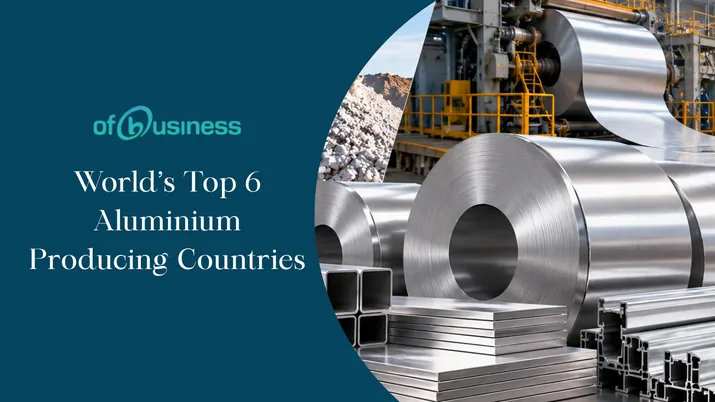
TL;DR: China is the largest aluminium producing country in 2026, at about 43 million tonnes, over 60% of world output. India ranks second at roughly 4.2 million tonnes, followed by Russia and Canada. Gulf output has fallen due to regional conflict, tightening global supply. Mentioned here are the top 10 producers and what it means for Indian buyers in sourcing.
China is the largest aluminium producing country in the world, making about 43 million metric tonnes in 2026. That is over 60% of global primary aluminium output (International Aluminium Institute and World Population Review, 2026). India ranks second at about 4.2 million tonnes, ahead of Russia at about 3.8 million tonnes.
Aluminium is one of the most abundant metals found on Earth’s crust. It is industrial material which is used in various applications worldwide. It is derived from bauxite, a common mineral found in many countries, which is refined into alumina and then aluminium using cryolite as a solvent.
In 2018, the US added aluminium to its list of critical metals. Although China is the largest aluminium producer globally, ongoing trade tensions between the US and China have led to concerns about the US’s secure aluminium supply chain. The US relies on aluminium imports due to a lack of domestic production capacity. In 2022, world output was 69 million metric tons, with China producing 40 million metric tons. In August 2026 alone, global primary aluminium production reached 6,172 thousand metric tonnes, and China contributed an estimated 3,874 thousand metric tonnes of it (International Aluminium Institute).
Table of Contents
Aluminium’s Features
Aluminium’s versatility makes it in high demand, and it is the second most malleable and sixth most ductile metal. Furthermore, it is non-toxic, lightweight, corrosion-resistant, and easily cast, machined, and formed. The metal is widely used in manufacturing products such as cans, foils, window frames, and aeroplane parts. It is also widely used in electricity transmission lines and as an alloy in steel manufacturing.
Quick Comparison of Top 10 Aluminium Producing Countries (2026)
The table ranks countries by estimated 2026 primary aluminium output. Country figures come from World Population Review and StatsPanda, cross-checked against IAI regional data.
| Rank | Country | Est. Output (2026) | Key Producers | Main Power Source |
| 1 | China | ~43.0 million MT | Hongqiao, Chalco, China Power Investment | Mostly coal; Yunnan hydro shift underway |
| 2 | India | ~4.2 million MT | Hindalco, Vedanta, NALCO | Captive coal-based power |
| 3 | Russia | ~3.8 million MT | Rusal | About 90% hydroelectric |
| 4 | Canada | ~3.3 million MT | Rio Tinto, Alcoa, Alouette | Hydroelectric |
| 5 | UAE | ~2.7 million MT | Emirates Global Aluminium | Natural gas |
| 6 | Bahrain | ~1.6 million MT | Alba | Natural gas |
| 7 | Australia | ~1.5 million MT | Rio Tinto (Tomago, Boyne Island) | Mixed grid |
| 8 | Norway | ~1.3 million MT | Norsk Hydro | Hydroelectric |
| 9 | Brazil | ~1.1–1.2 million MT | Alcoa (Alumar), Albras, CBA | Mostly hydroelectric |
| 10 | Malaysia | ~0.87–1.1 million MT | Press Metal | Mixed, with Sarawak hydro |
Below are the nations that make up the world’s top aluminium producing countries, based on 2026 International Aluminium Institute data and industry estimates:
- China- China produced about 43 million metric tons of aluminium in 2026, accounting for more than 60% of global output. Its production increased to a record high in 2022, boosted by newly launched capacity and a relaxation of power supply restrictions. Hongqiao (about 6.7 million tonnes a year) and Chalco (about 6.2 million tonnes a year) lead Chinese output. Chinese smelters are shifting capacity from coal-heavy Shandong to hydropower-rich Yunnan to cut carbon intensity.
- India- India produced about 4.2 million metric tons in 2026 and ranks as the second-largest aluminium producing country. In 2021, India produced 4 million metric tons of aluminium, surpassing Russia. Its aluminium output has grown consistently in recent years, and it is expected to reach 5 million metric tons by 2026-2027.
- Russia- Russia produced about 3.8 million metric tons in 2026, almost all of it through Rusal. Russia produced 3.7 million metric tons of aluminium in 2022, up slightly from 2011. The ongoing war with Ukraine and resulting sanctions are affecting the country’s ability to contribute to the global aluminium market. About 90% of Rusal’s metal uses Siberian hydropower, which gives it a very low carbon footprint.
- Canada- Canada produced about 3.3 million metric tons in 2026, powered mainly by hydroelectric smelting in Quebec. It remains the leading supplier of imported aluminium for the US, accounting for half of all imports.
- United Arab Emirates- The UAE produced about 2.7 million metric tons in 2026, almost entirely through Emirates Global Aluminium. It had risen from 2.54 million metric tons in 2021 to 2.7 million metric tons in 2022. In 2022, the nation provided 9% of the metal that the US imported.
- Bahrain- Bahrain produced about 1.6 million metric tons in 2026, mainly through Alba. It is a major aluminium producer in the Middle East.
- Australia: about 1.5 million metric tons in 2026. Australia is also a global leader in bauxite mining and a major alumina exporter.
- Norway: about 1.3 million metric tons in 2026, produced entirely on hydropower, mainly by Norsk Hydro.
- Brazil: about 1.1 to 1.2 million metric tons in 2026, mostly hydro-powered.
- Malaysia: about 0.87 to 1.1 million metric tons in 2026, led by Press Metal in Sarawak.
Why Is Global Aluminium Production Falling in 2026?
Global primary aluminium output fell about 1.5% year-on-year through late summer 2026. The main cause is a drop in Gulf production. IAI reporting says attacks on production facilities and shortages of raw materials have hit Gulf producers hard. The decline has tightened stocks on the London Metal Exchange and the Shanghai Futures Exchange.
Aluminium Industry in India: Producers and Production
India’s aluminium industry is led by Hindalco Industries, Vedanta Aluminium, and the state-owned National Aluminium Company (NALCO). Aluminium production in India reached about 4.2 million tonnes in 2026. Most smelters run on captive coal-based power, which keeps domestic costs steady but carries high carbon intensity.
Vedanta’s Jharsuguda smelter in Odisha has about 1.8 million tonnes of annual capacity, among the largest single-site smelters in the world. Its BALCO smelter in Korba, Chhattisgarh adds about 575,000 tonnes. Hindalco runs smelters at Renukoot, Hirakud, and Aditya Aluminium in Odisha. Vedanta is also expanding its Lanjigarh alumina refinery from 2 million to 5 million tonnes a year, which would cut India’s alumina import dependence.
Major Aluminium Smelters and Factories Worldwide
The world’s largest aluminium factories, or smelters, cluster near cheap power. The table lists key smelters with reported annual capacity.
| Smelter | Location | Capacity (MT/year) |
| Jharsuguda (Vedanta) | Odisha, India | ~1.8 million |
| BALCO (Vedanta) | Chhattisgarh, India | ~575,000 |
| Alouette | Quebec, Canada | ~575,000 |
| Alba | Bahrain | 1.6 million country total; Line 6 added 540,000 |
| Kitimat (Rio Tinto) | British Columbia, Canada | ~420,000 |
| Sunndal (Hydro) | Norway | ~400,000 |
| Tomago (Rio Tinto) | New South Wales, Australia | ~280,000 |
| Boyne Island | Queensland, Australia | ~270,000 |
For Indian buyers: Hindalco and Vedanta metal reaches buyers through distributors and B2B platforms such as OFB. Domestic supply avoids import duty and currency risk. With Gulf supply tight in 2026, buyers who relied on UAE or Bahrain material should compare domestic grades and other import origins. Large orders can use procurement credit through Oxyzo Financial Services, OFB’s RBI-registered NBFC partner.
Insight
Aluminium is a critical industrial material with versatile properties that make it highly demanded in various applications. However, geopolitical tensions and trade disputes between countries may affect the aluminium supply chain, leading to supply chain risks for industries that rely on this versatile metal. The 2026 Gulf disruption shows how quickly one region’s outage tightens global stocks. Therefore, ensuring a stable and sustainable aluminium supply chain is critical to maintaining the global economy’s stability.
Read More – Global Copper Shortage: An Overview
Frequently Asked Questions
India is second, at about 4.2 million metric tonnes in 2026. Hindalco, Vedanta, and NALCO lead Indian aluminium production. The Ministry of Mines expects output to reach 5 million tonnes by 2026–27.
India's aluminium industry is the world's second largest by output, at about 4.2 million tonnes in 2026. Odisha and Chhattisgarh host the biggest smelters. The industry serves construction, power transmission, packaging, and automotive buyers.
Output fell about 1.5% year-on-year through late summer 2026. The IAI links the fall mainly to Gulf producers, whose facilities and raw material supply were hit by regional conflict. The result is a supply disruption, not weaker demand.
Suggested Readings

Metals
MS Angle and Channel: Difference, Sizes & Weight
TL;DR: MS angle is an L-shaped steel section for bracing and light framing. MS channel is a C-shaped section that carries load across a span. Angles cost less to fabricate, while channels resist bending better. They are not interchangeable. This guide compares shape, weight, size, and cost, so fabricators and contractors can pick the right

Metals
ISMC Size Chart: MS Channel Weight per Meter, Sizes & Uses
TL;DR: MS channels come in standard ISMC sizes under IS 808, each with a fixed weight per meter that determines load capacity and material cost. ISMC 100 weighs 9.56 kg/m; ISMC 150 weighs 16.80 kg/m; ISMC 200 weighs 22.30 kg/m. This guide covers the full size chart, procurement checklist, and how to source verified MS
Metals
Steel Beam vs I-Beam: Structural Differences Explained
TLDR: Steel beam vs I-beam is a key comparison in construction, affecting strength, cost, and design. This guide explains structural differences, I-beam vs H-beam, beam dimensions, and standard I-beam sizes with charts. Understand steel beam vs I-beam clearly to choose the right section for better load performance and efficient material use. The comparison between steel

