
Latest Minimum Support Prices Announced For Kharif 2023-24 Crops
The Union Cabinet, chaired by Prime Minister Narendra Modi, has recently given the green light to a significant increase in the Minimum Support Prices (MSP) for kharif crops for the marketing season of 2023-24. Union Minister Piyush Goyal announced that this is the highest-ever growth in the MSP set by the Cabinet for the upcoming year.
Latest Change
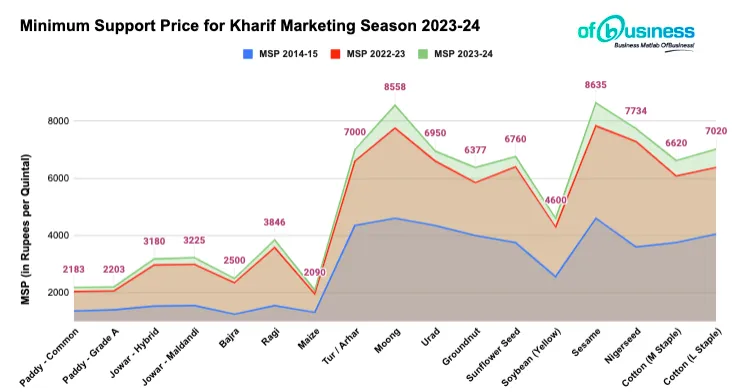
Here is the revised MSP for some of the major crops
- Paddy: ₹ 2,183 per quintal (+143)
- Paddy (Grade A): ₹ 2,203 per quintal (+143)
- Pigeon Peas (Tur): ₹7,000 per quintal (+₹400)
- Urad (Black Gram): ₹6,950 per quintal (+₹350)
- Moong (Green Gram): ₹8,558 per quintal (+₹803)
- Soybean: ₹5,726 per quintal (+₹540)
- Bajra (Pearl Millet): ₹2,478 per quintal (+₹128)
- Groundnut: ₹6,357 per quintal (+₹507)
- Sesame (Til): ₹8,635 per quintal (+₹805)
Key Highlights
Let’s delve into the major highlights of the MSP announcement:
- Encouraging Crop Diversification– The government’s decision to increase the MSP for all 14 kharif crops for 2023-24 aims to promote crop diversification. Paddy, the most widely cultivated crop, will see a 7% increase in MSP, which amounts to an additional Rs 143 per quintal. It is the second highest in the last decade, essential crops like green gram (moong) and oilseeds such as sesame and groundnut will experience an increase of more than 10%. Among cash crops, cotton will see a substantial 8.9% increase. This move is designed to motivate farmers to shift towards cultivating different crops, which can lead to higher returns for them and reduce India’s reliance on imports to meet domestic demand.
- Government’s Focus On Agriculture– Prime Minister Narendra Modi has emphasized that this year’s MSP increase is the highest compared to previous years, highlighting the government’s unwavering focus on the agriculture sector. By providing a favourable price structure for farmers, the government aims to uplift rural livelihoods and boost agricultural productivity.
- Impact On Inflation– While concerns may arise regarding the impact of MSP hikes on inflation, SBI Research suggests that the increase is unlikely to cause inflation as it depends on procurement, particularly for wheat, rice, and pulses by organizations like the National Agricultural Cooperative Marketing Federation of India (NAFED). The government is closely monitoring food inflation and regularly assessing the situation through a group of ministers led by Amit Shah.
OFB’s Insight
The government’s decision to increase the Minimum Support Prices for Kharif crops in the 2023-24 marketing season demonstrates its commitment to ensuring farmers receive fair prices for their produce. By encouraging crop diversification, the government aims to improve farmers’ income and reduce India’s dependence on imports. While concerns about inflation exist, expert opinions suggest that the MSP hikes are unlikely to have a significant impact. As India continues to make progress in foodgrains production, self-sufficiency in pulses and other essential crops is becoming a reality.
Read more: Toor Dal Prices Soar Amidst Government Procurements And Scarcity
For real time commodity prices, latest news, and insights, please download the all NEW and all FREE OfBusiness APP.
Suggested Readings
Parmal Rice vs Basmati Rice – Nutrition, GI and Health Benefits of Indian Varieties
TL;DR: Parmal rice is a non-aromatic, protein-rich variety from Punjab and Haryana with a low glycemic index — making it a practical choice for everyday health-conscious consumption. Basmati offers balanced amino acids, superior aroma, and a medium GI. Indrayani supports digestive health and carries a medium GI. This guide covers the nutritional profiles and GI
Edible Oil Importers in India: Duties, Supply and Industry Outlook
TL;DR: India’s vegetable oil imports fell 29% year-on-year in June 2026, but cumulative imports between November 2025 and June 2026 remained 6% higher. Lower domestic stocks, slower oilseed crushing and festive-season demand may support stronger imports in the coming months. Palm oil remains India’s largest imported edible oil, while India soybean oil imports have increased
8 Products Extracted From Sugarcane (Apart From Sugar And Ethanol)
Sugarcane is an incredibly versatile crop, there is a reason why it has been cultivated for thousands of years. It's one of the most popularly cultivated crops across the world, with over 80 countries cultivating it. Part of the reason for its success is its vast array of products that are made from sugarcane. Sugar and ethanol are two products derived from sugarcane and these two products are well known. But that’s not it. There are other products derived from sugarcane as well. In this article, we will describe other derived products derived from sugarcane as well.