
Why Is Indian Finished Long Steel Market Dull?
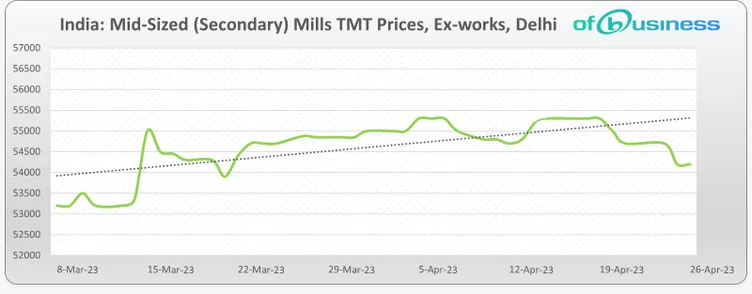
The Finished Long Steel market in India has witnessed a decline in TMT and Wire Rod prices in the last two days. While rumors of a price correction of around Rs. 500/ton in primary TMT are doing rounds, major players are not willing to reduce prices during month-end. However, market participants are awaiting the price revision in the next month. In this article, let’s explore why the market is lackluster.
Factors Impacting Finished Long Steel Market
- Slow Buying- The market has remained less supported, and no major inquiries have been noticed due to slow buying. Meanwhile, sentiments for the secondary TMT segment have also been less responsive due to cautious and need-based buying. As the market is highly volatile, traders and distributors remain less active, and they have been seen offering material at high discounted prices just to clear their stocks.
- Dull Trend For Finished Long Steel- The overall trend for Finished Long Steel is dull, with buyers opting for wait-and-watch mode. In last two days, the secondary market noticed an overall downfall of around Rs. 300-900/ton pan India. Secondary Wire Rod prices plunged up to Rs. 900/ton to Rs. 50,400/ton ex-Raipur and Rs. 50,700/ton ex-Durgapur, respectively.
Secondary TMT Price Correction
The mid-sized mills were seen offering TMT at Rs. 50,000-50,300/ton ex Raipur (down by Rs. 700/ton), and Rs. 54,200/ton ex Delhi NCR (down by Rs. 700/ton). A maximum fall of Rs. 900/ton was observed in Jalna, Maharashtra, to around Rs.54,300-54,600/ton, while in Hyderabad, a price correction of Rs. 500/ton was noticed to Rs. 54,000-54,500/ton. All prices are on an ex-plant basis, excluding GST.
Market Outlook
As mentioned above, the market is in a wait-and-watch mode, and only requirement-based buying is going on. The market is likely to remain volatile further and market participants are waiting for next month’s price revision, as per sources reported to ofbusiness.
OFB’s Insight
The Steel market in India is currently witnessing a decline in TMT and secondary Wire Rod prices. Despite rumors of a price correction in Primary TMT, major players are not willing to reduce their prices amid month-end. Slow buying and cautious, need-based purchasing have resulted in a less supported market. Traders and distributors remain less active, and the overall trend for the Finished Long Steel market is dull. It remains to be seen how the market performs in the coming days.
Read more: Steel Market Update: Why Are Scrap Prices Falling In India?
For real time commodity prices, latest news, and insights, please download the all NEW and all FREE OfBusiness APP
Suggested Readings

ISMC Size Chart: MS Channel Weight per Meter, Sizes & Uses
TL;DR: MS channels come in standard ISMC sizes under IS 808, each with a fixed weight per meter that determines load capacity and material cost. ISMC 100 weighs 9.56 kg/m; ISMC 150 weighs 16.80 kg/m; ISMC 200 weighs 22.30 kg/m. This guide covers the full size chart, procurement checklist, and how to source verified MS

MS Angle vs Channel: Steel Section Comparison
TL;DR: MS angle and MS channel are both hot-rolled structural steel sections, but they are not interchangeable. Angles suit bracing and lightweight framing, while channels carry higher loads across a span. This guide compares their standards, weight, cost, and buying process so fabricators and contractors pick the right section on OFB. MS angle and MS
Steel Beam vs I-Beam: Structural Differences Explained
TLDR: Steel beam vs I-beam is a key comparison in construction, affecting strength, cost, and design. This guide explains structural differences, I-beam vs H-beam, beam dimensions, and standard I-beam sizes with charts. Understand steel beam vs I-beam clearly to choose the right section for better load performance and efficient material use. The comparison between steel

