
The main difference is thickness. Plate is thicker and heavier, and sheet is thin and flat. The cutoff varies: ASTM A480 treats about 5 mm and above as plate, while Indian trade often uses 3 mm to 6 mm. Sheets suit light fabrication, and plates suit heavy structural or pressure work.
Metals
Stainless Steel Coil vs Sheet vs Plate: When to Use What?
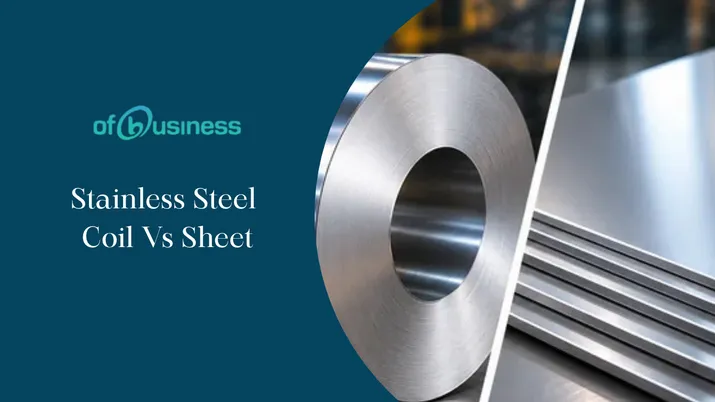
TL;DR: Coil, sheet and plate are three forms of the same stainless steel, sold by thickness and shape. Coil is a continuous roll for high-volume production. Sheet is thin flat stock for panels and appliances. Plate is thick flat stock for structural and pressure work. This guide compares them, explains how to choose, and shows how to source verified stainless steel on OFB.
Stainless steel coil, sheet and plate are the three flat forms buyers choose between, and the choice affects cost, fabrication method and wastage. The main difference is thickness and shape: coil is rolled, sheet is thin and flat, plate is thick and flat. This guide compares them with IS and ASTM references and shows how to source them through OfBusiness (OFB), a B2B industrial procurement platform.
What is the main steel plate vs sheet difference?
What Is the Difference Between Stainless Steel Coil, Sheet and Plate?
Stainless steel coil is a continuous strip wound into a roll. Sheet is thin flat stock cut from coil. Plate is thick flat stock, usually hot-rolled individually. The cutoff between sheet and plate varies by standard. ASTM A480 treats about 5 mm and above as plate, while Indian trade often uses 3 mm to 6 mm. Always specify exact thickness.
| Stainless Steel Coil vs Sheet vs Plate | |||
| Parameter | Coil | Sheet | Plate |
| Form | Continuous roll | Flat rectangular | Thick flat block |
| Thickness | Thin to medium | Thin; below about 3–6 mm | Above about 3–6 mm |
| Typical rolling | Hot-rolled or cold-rolled | Mostly cold-rolled | Hot-rolled |
| Common finish | No.1, 2B, BA | 2B, BA, No.4 | No.1 |
| Standards | IS 6911, ASTM A240 | IS 6911, ASTM A240 | IS 6911, ASTM A240 |
| Handling | Needs uncoiling or slitting | Ready to cut and form | Needs heavy lifting |
| Typical use | Mass-produced formed parts | Appliances, panels, enclosures | Tanks, pressure vessels, base plates |
| Pricing basis | Per tonne; lowest processing charge | Per tonne plus cut-to-length charge | Per tonne plus cutting charges |
The table is indicative. Thickness cutoffs and processing charges vary by supplier, so confirm both before ordering.
Defining the Forms: Stainless Steel Coil vs Sheet vs Plate
To make a procurement decision, first understand what each form physically is.
- Stainless Steel Coil
A stainless steel coil is a long, continuous strip rolled into a circular roll after passing through a rolling mill. It can be hot-rolled or cold-rolled.
- Best for: Businesses with automated machinery, such as CNC punching or roll forming, that need a constant feed of material.
- Handling: Coils need an uncoiler and leveller, or a slitting or cut-to-length service, before use.
- Stainless Steel Sheet
A stainless steel sheet is coil that has been cut to length and flattened. Common stock sizes include 1,219 × 2,438 mm (4 ft × 8 ft) and 1,250 × 2,500 mm, but confirm sizes with your supplier.
- Best for: General fabrication, kitchen equipment, enclosures and automotive trim.
- Surface finish: Sheets often come with specific finishes such as 2B, BA or brushed No.4, ready for visible products.
- Steel Plate
A steel plate is thicker and heavier than a sheet. Thick material is usually rolled as individual plates, because it is too stiff to coil practically. The same word covers carbon steel plate and stainless steel plate.
- Best for: Heavy fabrication, pressure vessels, process tanks and base plates.
- Durability: Gives the highest structural support and load-bearing capacity.
Carbon steel plate and stainless steel plate are different products. Carbon steel plate to IS 2062 is the default for most structures. Stainless steel plate is chosen where corrosion resistance or hygiene matters.
The Steel Plate vs Sheet Difference: A Deep Dive
The steel plate vs sheet difference comes down to thickness, rolling process, finish and job. Thickness decides load capacity. Rolling decides surface quality. Together they decide whether the material works as structure or as skin.
Thickness and Gauge: The most obvious difference is thickness. Plates are designed for heavy-duty performance. If your project involves high pressure or heavy structural loads, a thin sheet will deform where a plate will hold. Conversely, using plate for a light job adds unnecessary weight and cost.
Manufacturing Process and Finish: Stainless steel sheets are mostly cold-rolled, which gives a smoother surface such as 2B or BA. Plates are typically hot-rolled and supplied with a No.1 finish, which is rougher. This process is more cost-effective for thick sections, and the finish is usually acceptable where the metal is not on show.
Application Intent: Think of the plate as the “bone” of a project and the sheet as the “skin.” Use plate for machine bases, pressure parts and tank shells. Use sheet for casings, panels and decorative trim.
Which Standards and Grades Apply to Stainless Steel Coil, Sheet and Plate?
Indian stainless flat products are covered by IS 6911 for plate, sheet and strip. ASTM A240 is the common specification for grades 304 and 316 plate, sheet and strip. ASTM A480 sets general requirements such as finishes and tolerances. Grade 304 suits general use, and grade 316 suits chloride and chemical exposure.
| Stainless Steel Surface Finishes | |||
| Finish | Process | Typical form | Typical use |
| No.1 | Hot-rolled, annealed and pickled | Plate, hot-rolled coil | Tanks, industrial equipment |
| 2B | Cold-rolled, annealed, pickled and skin-passed | Sheet, cold-rolled coil | General fabrication |
| BA | Cold-rolled and bright annealed | Sheet, cold-rolled coil | Reflective surfaces, appliances |
| No.4 | Brushed finish on 2B | Sheet | Kitchen equipment, architecture |
When to Use Stainless Steel Coil in Manufacturing?
Use stainless steel coil when you make thousands of identical parts and own uncoiling or forming equipment. Coil lowers the processing charge and scrap, and it feeds stamping presses, roll formers and laser lines continuously.
- Reduced waste: Pre-cut sheets leave off-cuts. With coil, you cut only the length you need and plan nesting around the strip width.
- Lower processing charge: Cut-to-length sheets usually carry a processing charge over coil. Freight is typically quoted per tonne, so form affects cost mainly through processing and scrap.
- Automation: A coil feeder lets presses and cutting lines run for hours without manual intervention.
Read more: Stainless Steel Uses in Industrial Manufacturing
Industrial Applications of Steel Plates
Steel plates serve heavy fabrication. Stainless plate is used where load and corrosion resistance combine, such as process and chemical tanks, pressure vessels, heat exchangers and base plates in corrosive plants. Carbon steel plate covers most bridges, building frames and ship hulls.
- Construction: Base plates for columns and fabricated beams, in carbon steel or stainless depending on exposure.
- Process industry: Storage tanks and reactors for chemicals, food and water.
- Maritime: Chemical tankers use stainless or duplex plate for cargo tanks, while hulls are generally carbon steel.
Buyers who source steel plates online for industrial use should specify grade, standard, thickness tolerance and finish, then check the Mill Test Certificate. For stainless work, grades such as 304 or 316 are specified to match the environment the plate will face.
Choosing the Right Form for Your Business
Choose by your machinery and end product. Coil suits high volume with uncoiling equipment, sheet suits custom fabrication, and plate suits parts that carry load or pressure. The table maps each need to a form.
| Which Form to Choose | ||
| Your situation | Choose | Why |
| High-volume stamping or roll forming | Coil | Lowest processing charge, continuous feed |
| Custom kitchen equipment or enclosures | Sheet | Ready to cut, finish options |
| Pressure vessels, tanks, base plates | Plate | Thickness and load capacity |
| Mixed small orders, no uncoiling line | Sheet | No handling equipment needed |
| Corrosive plant with heavy loads | Stainless plate | Strength with corrosion resistance |
How Do You Calculate the Weight of Stainless Steel Sheet and Plate?
Weight in kilograms equals thickness in millimetres × width in metres × length in metres × 7.93 for grade 304. Grade 316 is slightly denser at about 8.0 g/cm³. A 2 mm sheet of 1,250 × 2,500 mm weighs about 49.6 kg. A 10 mm plate of 1,500 × 6,000 mm weighs about 714 kg.
Since stainless steel is priced per tonne, weight drives order cost. Use mill-quoted weights for final orders, because tolerances shift actual weight.
How to Buy Stainless Steel Coil, Sheet or Plate
Buying stainless steel flat products takes seven steps: fix the form and thickness, specify grade and standard, set size and finish, request the Mill Test Certificate, verify identity, compare quotes on one basis, and inspect on delivery. Most disputes come from grade substitution or thickness shortfall.
- Fix the form and thickness, for example 2 mm sheet or 10 mm plate.
- Specify the grade and standard, such as 304 to IS 6911 or ASTM A240.
- Set width, length or coil weight, and the finish (No.1, 2B, BA or No.4).
- Request the Mill Test Certificate showing heat number, chemical composition and mechanical properties.
- Run a positive material identification test on a sample. A magnet is not a reliable grade test.
- Compare quotes on the same basis: per tonne, ex-works or delivered, with processing charges listed.
- Inspect thickness, flatness, surface and markings against the purchase order.
What Determines Stainless Steel Prices in India?
Stainless steel prices are driven mainly by nickel and molybdenum costs, then by grade, finish, form, thickness and order volume. Nickel is typically the largest cost input in grade 304, so prices follow LME nickel.
Check live Stainless Steel Prices
Plate and cut-to-length sheet usually carry cutting or processing charges on top of the base rate. Request quotes that list these charges separately. All prices are indicative as of November 2026, on an ex-Mumbai basis, and subject to market fluctuations. Contact OFB for current pricing.
How to Procure Stainless Steel Through OFB?
OFB connects industrial buyers with verified suppliers of stainless steel coils and sheets in grades such as 304, 316L, 202 and 430, with finishes including 2B, BA and No.4. Buyers can compare grade-wise rates on one platform. Confirm availability of plates and specific thicknesses with the OFB category team.
OFB’s supplier network undergoes quality and compliance verification. Confirm individual supplier certifications, including Mill Test Certificates, at the point of order. Large orders can use procurement credit through Oxyzo Financial Services, an RBI-registered NBFC. Delivery timelines are subject to location, order volume and logistics partner availability.
Conclusion
Match the form to your machinery and your end product. Choose coil for volume, sheet for custom fabrication and plate for load or pressure, then fix grade, standard and thickness in writing. Explore OFB’s stainless steel category to compare verified suppliers, with procurement credit through Oxyzo for large orders.
Frequently Asked Questions
Coil usually carries a lower processing charge than cut-to-length sheet, so it often costs less per tonne for large manufacturers. If you lack machinery to uncoil, level and cut it, sheet is usually the better choice for smaller shops. Compare quotes with processing charges listed.
Steel plates are used for base plates, pressure vessels, process tanks, heat exchangers and heavy fabrication. Carbon steel plate covers most bridges and building frames. Stainless steel plate is chosen where corrosion resistance or hygiene is needed alongside strength.
Yes, but verify before ordering. Confirm the grade, standard, thickness tolerance and finish, and ask for the Mill Test Certificate. For large orders, run a positive material identification test on a sample. Buy from suppliers whose certifications you can check.
Magnetism depends on the alloy. Ferritic grades such as 430 and martensitic grades are magnetic. Austenitic grades such as 304 and 316 are generally non-magnetic, though cold working can make them slightly magnetic. The stainless steel composition, not the form, decides this, so a magnet is not a reliable grade test.
Suggested Readings

Metals
MS Angle and Channel: Difference, Sizes & Weight
TL;DR: MS angle is an L-shaped steel section for bracing and light framing. MS channel is a C-shaped section that carries load across a span. Angles cost less to fabricate, while channels resist bending better. They are not interchangeable. This guide compares shape, weight, size, and cost, so fabricators and contractors can pick the right

Metals
ISMC Size Chart: MS Channel Weight per Meter, Sizes & Uses
TL;DR: MS channels come in standard ISMC sizes under IS 808, each with a fixed weight per meter that determines load capacity and material cost. ISMC 100 weighs 9.56 kg/m; ISMC 150 weighs 16.80 kg/m; ISMC 200 weighs 22.30 kg/m. This guide covers the full size chart, procurement checklist, and how to source verified MS
Metals
Steel Beam vs I-Beam: Structural Differences Explained
TLDR: Steel beam vs I-beam is a key comparison in construction, affecting strength, cost, and design. This guide explains structural differences, I-beam vs H-beam, beam dimensions, and standard I-beam sizes with charts. Understand steel beam vs I-beam clearly to choose the right section for better load performance and efficient material use. The comparison between steel

