
Unpredictable Fluctuations And Natural Disasters: What's Happening In Indian Kabuli Chana Market?
The Kabuli chickpeas market has been experiencing fluctuations due to several factors, including production estimates, oversupply in the market, and natural disasters affecting crops in other countries. However, the market has been showing strong performance despite these circumstances. In this market, we will explore more about the Kabuli chana market in India.
Current Market Scenario
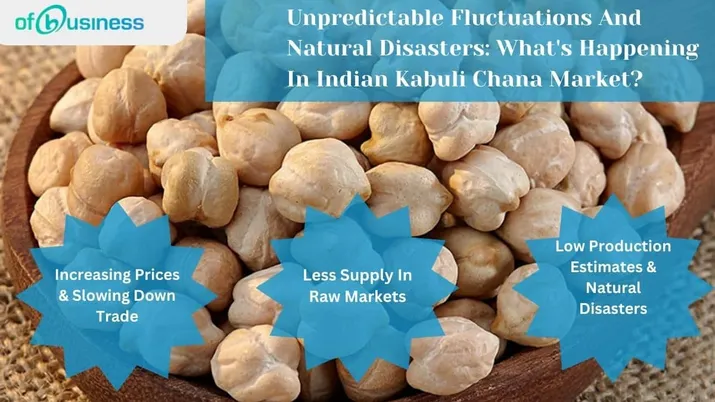
- Increasing Prices & Slowing Down Trade– The price of Kabuli chickpeas has increased by 4-6 rupees per kilogram in the last week, leading to a slowdown in its trade due to low profitability. Some traders had already reduced their stock at lower prices due to the likelihood of increased production. Meanwhile, there is a shortage of stock in the Madhya Pradesh market, and large quantities of goods are being exported from the Indore-Bhopal line.
- Less Supply In Raw Markets- Farmers have been continuously bringing their produce to the markets due to the low prices they have been receiving, leading to less supply in the raw markets. Traders in Haryana, Punjab, Jammu and Kashmir, Himachal, and other states have refused to purchase goods due to the oversupply in the market.
- Production Estimates & Natural Disasters- The production was estimated to be 20 million metric tons, which is more than 15 million metric tons in 2022. However, production estimates for the ongoing season were only 18 million metric tons due to poor crop pollination. Moreover, the old stock of three million metric tons has been depleted to zero this year. In addition, crops, including Kabuli chickpeas, have been destroyed in Turkey, Syria, Sudan, and other places due to natural disasters and other calamities.
OFB’s Insight
The Kabuli chickpeas market has been fluctuating due to several factors, including oversupply, low profitability, and natural disasters affecting crops in other countries. However, the market has been showing strong performance despite these circumstances. The Kabuli chana market is one to keep an eye on in the coming months as the industry navigates these challenges.
For real time commodity prices, latest news, and insights, please download the all NEW and all FREE OfBusiness APP.
Suggested Readings
Parmal Rice vs Basmati Rice – Nutrition, GI and Health Benefits of Indian Varieties
TL;DR: Parmal rice is a non-aromatic, protein-rich variety from Punjab and Haryana with a low glycemic index — making it a practical choice for everyday health-conscious consumption. Basmati offers balanced amino acids, superior aroma, and a medium GI. Indrayani supports digestive health and carries a medium GI. This guide covers the nutritional profiles and GI

Edible Oil Importers in India: Duties, Supply and Industry Outlook
TL;DR: India’s vegetable oil imports fell 29% year-on-year in June 2026, but cumulative imports between November 2025 and June 2026 remained 6% higher. Lower domestic stocks, slower oilseed crushing and festive-season demand may support stronger imports in the coming months. Palm oil remains India’s largest imported edible oil, while India soybean oil imports have increased

8 Products Extracted From Sugarcane (Apart From Sugar And Ethanol)
Sugarcane is an incredibly versatile crop, there is a reason why it has been cultivated for thousands of years. It's one of the most popularly cultivated crops across the world, with over 80 countries cultivating it. Part of the reason for its success is its vast array of products that are made from sugarcane. Sugar and ethanol are two products derived from sugarcane and these two products are well known. But that’s not it. There are other products derived from sugarcane as well. In this article, we will describe other derived products derived from sugarcane as well.